Showing posts with label crítica. Show all posts

Sunday, April 18, 2010

The Deer House


The Deer House
Needcompany, Belgium
William Shakespeare Theater
3 April 2010

On 1 April at the Gabriel Garcia Marquez Cultural Center author and director Jan Lauwers gave a thoughtful and thorough conference about his work with Needcompany and the play The Deer House.

The Deer House is the third part of a trilogy about loss. The first installment, Isabelle's Room, set in the past, was performed at the Iberoamerican Theater Festival two years ago. The Lobster Shop, set in the future, is not widely performed because it does not follow a linear story line and it can be overly-challenging for audiences. The Deer House, set in the present, is what Needcompany brought to this year's festival in Bogota.

The play grew out of the experience of one of the dancers with the theater company whose brother, a photojournalist, was killed in Kosovo. That was the starting point but, as Lauwers observes, the personal story has to become universal to make it interesting, to make it relevant. He stresses that art must transcend political and cultural barriers to be able to speak to people in different countries.

Lauwers is the author, but he is always aware of the performers for whom he is writing as he develops the script. Some of the scripting is written, some of it is presented to the performers as guidelines and they are given the task of communicating in their own way. The cast includes individuals trained as actors, singer, and dancers, so each one has their own way of communicating with the audience and in interactions with each other. Giving the actors control over their performances also keeps it fresh. In Lauwers' words, every performance should look like it is being improvised. Lauwers is also a plastic artist who works in painting and sculpture. The Deer House is a very sculptural piece. Lauwers and Needcompany often work in art installations. The Deer House reflects this style of working and conveys a strong sense that the characters are the medium and the message, and that any living medium is temporal. I saw the play with my friend Sally who observed that "Although it was rather visually challenging and hectic with a lot (too much) going on at the same time, it did convey the idea that while something dramatic is going on for one person (the one whose brother was killed) and raises concern among the rest of the group, their everyday lives are running on as usual in the background. People threw in their comments on the situation (or any situation) and sparred off each other to provoke some amusing observations…"

In the performance the actors relate to each other on different levels, as actors, characters, and individuals. The play itself is divided into two sections: the first part takes place in the dressing room. The actors receive the news about the brother's death as they are getting into costume and warming up. In the second part they are in costume and enact the story of the brother and the family of the woman who he unwillingly condemned to die.

Coming out of this conference, and being impressed with the thought process and rehearsal that goes into the performance, I had high hopes for the production which I saw two days later on 3 April. I was not altogether satisfied with the end product. True to his word, the energy and the intensity were there, but the whole thing didn't quite gel.

Grace, in the character of the mentally challenged girl gives a convincing if grating performance. Lauwers writes a part for everyone, whether it makes any sense in the storyline or not. Yumiko and Misha did not really fit into the story. Their presence, and the plot distraction in which Yumiko is discovered skulking around the dressing room and is suspected of having stolen a cellphone, seemed out of place and forced. Viviane, as the family matriarch, lacked force and presence.

Thematically, this play deals with death. The deer die. The daughter Inge is dead. The photojournalist, forced to condemn Inge to death in a macabre choice, is killed by Inge's husband Julien. The daughter who was "saved" when Inge was killed, commits suicide. Julien is killed "accidentally." It is bleak and hopeless. According to the blurb, the end of the play is meant to convey a sense of hope and salvation, but when Grace "saves" the deer by leading them to shelter in the valley, it feels more like a fluke. There is no real reason for hope. Chaos reigns in the outside world, and chaos, eros and thanatos reign in The Deer House where this group of people has sought to live outside of the evil influences of the world. Perhaps they have been living in their bubble too long and it is time that they joined the real world again.

Why the Deer House? By way of explanation for the deer motif, Lauwers commented that the fact that deer still live in close proximity to the cities of the industrialized world gives him hope. It suggests to him that survival is still possible, despite the odds against them. A deer house itself refers to the tradition of harvesting deer horns, which is a brutal practice that sometimes kills the deer, and yet the animals survival to live another year and grow another set of horns. The characters in The Deer House, care for the deer, are the cause of their death, and they are the deer themselves.

This is a bold and experimental piece of work. I wouldn't say that I liked it. I have some reservations about the way that each character is incorporated into the story, and I question whether the author succeeds in conveying his message. But I am intrigued and interested enough that I would go see another performance by Jan Lauwers and Needcompany (I just don't want to see this one again).

Sunday, April 4, 2010

Carillon - 2666


Carillon
Kitonb, Italy
Bogotá Bullfighting Ring
1 April 2010


It is nice that the theater festival offers different kinds of performance for different audiences. Carillon was billed as one of the “must see” shows for the whole family. Indeed I bought tickets for the whole family because it looked interesting.

The narrative pretext of the story of the creation of the world, something to do with Jupiter and bringing life to the universe, and there was something to do with the bronze age and the iron age… and a flood. If I’m a little shaky on the details, that is because the narration was so distorted that was practically inaudible. In contrast the sound for singer Rosie Wiederkehr was excellent; the music was beautiful but abstract. So let’s forget the story and just focus on the visual elements.

This is large-scale spectacle. The structure that is used for the stage was not placed in the center of the bullfighting ring, but rather at one end. My seat location, facing stage center across the ring, was a bit too far away, defeating the sense of grandeur. The cheap seats on the sides had a much better view. An extra large crane was brought in from the oilfields to maneuver the performers into position so that they appear high in the sky at different moments during the performance. These moments were beautiful, otherworldly, and sent shivers down my spine.

The best moments in the show were the appearance of the performers overhead, and the scene that had the dancers tumbling through bungee cords that are laced across the metal structure that is the main staging element, to the strains of the fast segment of Summer from Vivaldi’s Four Seasons.

Overall conclusion: It was pretty cool but Carillon did not live up to the hype. I wish I'd paid less and had better seating. If it had been free street theater, I would have said it was fantastic. Having paid, I didn't feel that I got my money's worth.


2666
Lliure Theater, Spain
Bellas Artes Theater
2 April 2010

Director Alex Rigola takes on the ambitious task of adapting Chilean author Roberto Bolaños' book by the same name for theater.

Following synopsis of the story is taken from Wikipedia: "The novel and the play are told in five parts, all linked by varying degrees with the unsolved murders of upwards of 300 young, poor, mostly uneducated Mexican women in Ciudad Juárez (Santa Teresa in the novel). The Part about the Critics describes a group of four European literary critics who have forged their careers around the elusive German novelist Benno von Archimboldi. Their search for Archimboldi ultimately leads them to the Mexican border town of Santa Teresa in Sonora. The Part about Amalfitano concentrates on Oscar Amalfitano, a professor of philosophy at the University of Santa Teresa, who fears his daughter will be caught up in the violence of the city. The Part about Fate follows Oscar Fate, an American journalist for a black interest magazine, who is sent to Santa Teresa to cover a boxing match (despite knowing very little about boxing) but becomes interested in the murders. The Part about the Crimes chronicles the murders of hundreds of women in Santa Teresa from 1993 to 1997. It also depicts the police force in their apathetic attempts to solve the crimes. The Part about Archimboldi reveals that the mysterious writer is in fact Hans Reiter, born in 1920 in Prussia. This section explains how a provincial German soldier on the Eastern Front became an author in contention for the Nobel Prize."

Overall director Rigola does an excellent job. Bolaños' novel is close to 1,000 pages. As such, directing choices need to be made to produce a coherent piece of theater. Rigola uses a combination of narration, having characters "tell" the story, alongside enactment. The device works very well, and reminds the audience that this is, after all, a novel.

The contrasts are striking: The academics, their obsessions and romances. The gritty underworld of Santa Teresa, which is completely relevant to Bogota and the darker side of its nightlife in a developing country. The misogynistic police force's indifference to the deaths of the women. The scene of the murdered body that is discovered in the desert illustrates the indifference of the police, who stand around telling sexist jokes, as a long list of murder victims, their names and ages, scroll past on the wall of the crime scene tent that covers the back of the stage. The corpse (at first I thought it was a dummy, she was so still) begins to writhe and scream and beg for mercy, but the police cannot hear her. The visceral reality of the scene, and the sensation that it conveys of being just one more incident in an interminable series, is horrifying. The final scene reveals the identity of the mysterious Archimboldi, telling the story of his life. A lot of information presented in this scene, and the performers have to race through their lines at a breakneck speed. It does not quite hold together with the rest. The themes of death and violence remain important, a comparison is suggesting between the Santa Teresa murders and the barbarity of nazi atrocities. Still, the author's life story becomes an academic exercise and is anticlimactic after all that has come before. The play loses momentum and dramatic tension.

I suspect that the difficulty lies with the fact that this is an adaptation from a novel and director wanted to remain true to the author’s vision. Of course a novel gives you more time to develop the story and create the necessary links. With a running time of nearly five hours (with four intermissions), there just wasn't enough time to make the last scene hold together. Despite this shortcoming, I felt that this was a brilliant piece of theater.

All of the performances were excellent, with the cast members playing multiple roles. Unfortunately the night I saw the show one of the actresses was not well and was unable to finish the performance. She had to be replaced during the last scene. I applaud the group for continuing the performance; having the replacement actress reading the script onstage was not a problem. Each performance had very clear directing codes. Each scene had different assignments for the use of physical space, and most were very successful. One actor had the job of expressing himself through dance. He was a “mute chorus,” placed in the background and providing physical, non-verbal commentary throughout the scenes. I thought it was a magnificent directing choice and an excellent, intensely focused performance. It felt fresh. In many of the scenes, the performances switched between expository narration and interaction. The transitions were smooth and effective. It is literary device and it worked very well. I loved the staging. In every case the sets created and complemented the atmosphere that was sought.

This was an ambitious and daring project. Kudos to Lliure Theater for their effort.


The reviews for the two shows I saw at the theater festival: Break Out by the Seven Sense Theater Company of Korea, The Deer House by Needcompany of Belgium, and the festival's closing ceremony Jouers de Lumiere by Group F of France, as well as my recap of festival highlights, will have to wait until I get back from the coast. So, dear readers, we will have a week off before there is a new entry.

Thursday, April 1, 2010

La Orgía - Por qué, Por qué? (Why, Why?)


La Orgía
Barco Ebrio, Colombia
Teatro Leonardus
30 March 2010


La Orgía by Enrique Buenaventura uses black humor and pantomime slapstick as the vehicle for this piece of social commentary in which three down and out homeless people (the original text has four, but director/performer Beatriz Monsalve has eliminated one of the characters and updated the script) gather for the "orgy," a monthly event that an elderly prostitute pays them to attend and reenact the days of her former glory.

Each character represents one of "oligarchies" of Colombian society: the monied political class --still referred to as the elites in Colombia-- considered responsible for much of the violence in the country. The former Colonel, wearing a US motif t-shirt who goes on about the sacrifice of having allegedly lost his leg in battle, when it is obviously still attached to him and turns out to be perfectly functional. The "dwarf" who enacts the part of the Bishop, played by a full-sized actress in a costume that is as wide as it is tall; it is a gorgeously Botero image. The main character, the old woman who has whored herself to all of them. And her son, the mute, represents the silent masses in Colombia, whose voice is never heard, while the rest divvy up the country and fight amongst themselves.

The play uses pantomime conventions of role reversal and dressing up, slapstick, sexual innuendo, all carefully referenced within the Colombian context. The style is anti-naturalistic, theater of the grotesque. Everything is larger than life. From the heavy make-up and gaudy costumes, to the stylized performances, it is all in your face. It is not that I don't get it: I understand that this is "social commentary," but I found it worn and simplistic. The audience, however, loved it. On the upside, Iván Barlaham Montoya gave a beautiful performance as Tísico-Jacobo, the beggar-aristocrat.


La Orgía
Barco Ebrio, Colombia
Teatro Leonardus
30 de marzo 2010


La Orgía de Enrique Buenaventura utiliza el humor negro y la pantomima cómica como el vehículo para el comentario social en el cual tres mendigos (el texto original tiene cuatro, pero director y actriz Beatriz Monsalve eliminó uno de los personajes y actualizó el guión) se reúnen para La orgía, un evento mensual convocado por una prostituta anciana quien les paga para asistir y representar sus días de gloria del pasado.

Cada personaje representa una de las "oligarquías" de la sociedad colombiana: la clase política adinerada --que todavía se conoce como las elites en Colombia-- considerada responsable de gran parte de la violencia en el país. El ex coronel, con una camiseta estampada con una bandera norteamericana, quien lamenta el sacrificio de haber supuestamente perdido una pierna en la guerra, cuando es obvio que todavía conserva su pierna y resulta ser perfectamente funcional. La "enana", quien asume el papel del obispo, interpretada por una actriz de tamaño normal con un vestido que es igual de ancho como es de alto, es una imagen magníficamente Boteriano. El personaje principal, la anciana quien se ha prostituida con todos ellos. Su hijo, el mudo, quien representa a las masas silenciosas en Colombia, cuya voz nunca se escucha, mientras los otros reparten el país y pelean entre ellos.

La obra utiliza las convenciones de pantomima: el cambio de papeles, disfraces, comedia física, insinuaciones sexuales, todo con referencia al contexto colombiano. El estilo es anti-natural, el teatro de lo grotesco. Todo sale de los parámetros de lo natural. Desde el pesado maquillaje y el vestuario, a la actuación estilizada, todo está en sus narices. No es que no entiendo la propuesta: entiendo que es "crítica social", pero me pareció desgastado y simplista. El público, sin embargo, le encantó. Por el lado positivo, Iván Montoya Barlaham ofreció una actuación hermosa como Tísico-Jacobo, el mendigo aristócrata.


Warum, Warum? (Why, Why?)
Peter Brook, Zurich Schauspielhaus, Switzerland
Teatro Nacional Fanny Mikey
31 March 2010


When making my selections for the theater festival, I tend to veer away from anything that is going to involve reading a lot of subtitles; meaning anything that is strongly language-dependent that will not be performed in a language that I understand. I was hoping that Peter Brook's reflection on the art and practice of theater would be performed in English or French. It was in German. From there I have to ask the question: Would I have been better off reading the text rather than seeing it performed? The answer to that question is a resounding no. Miriam Goldschmidt gave a wonderfully expressive performance as she reflected on the craft of theater and why it ranks among the arts, as opposed to being merely entertainment. I enjoyed the production but, that being said, it was a piece of navel-gazing: it is a play about theater. The reflection is interesting, and I liked the references to different playwrights that Brook intersperses into the text as examples of the challenges that performers face and the universality of the themes that theater addresses, but can an academic debate translate into theater itself? I felt that this performance would not have been out of place among the storytellers that I have seen on the terrace at Compensar. At what point does good craftsmanship and storytelling make the transition into art?

I rearranged my festival schedule to attend this play, and so my expectations were high. Goldschmidt gave a very good performance and I loved the music by Francesco Agnello (what is that instrument anyway?). I acknowledge that this show is playing to the right audience, and it was a creative way of breathing life into what would otherwise be an academic debate. Still, I feel a bit let down. This was a coy variation on Inside the Actor's Studio, and I would rather have heard Brook speaking in his own voice, although I grant him the prerogative to turn the situation around and defy expectations. That is his art, after all.


Por qué, por qué?
Peter Brook, Zurich Schauspielhaus, Suiza
Teatro Nacional Fanny Mikey
31 de marzo 2010

Al hacer mis selecciones para el festival de teatro, tiendo a evitar obras que implicarán la lectura de una gran cantidad de subtítulos, o sea obras que dependen fuertemente del lenguaje si la presentación no se llevará a cabo en un idioma que entiendo. Tenía la esperanza que esta reflexión de Peter Brook sobre el arte y la práctica del teatro estaría hablada en inglés o francés. Era en alemán. A partir de ahí, me hice la pregunta: ¿Habría sido mejor leer el texto en lugar de ver la presentación? La respuesta a esa pregunta es un no rotundo. Miriam Goldschmidt ofreció una actuación maravillosamente expresiva en esta reflexión sobre el teatro y la razón por la que se considere entre las artes, en lugar de ser meramente entretenimiento. Disfruté la obra pero, dicho esto, fue una especie de ejercicio de auto-contemplación: es una obra de teatro sobre el teatro. La reflexión es interesante, y me gustó las referencias a diferentes autores que Brook intercaló en el texto como ejemplos de los desafíos los actores enfrentan y la universalidad de los temas que el teatro aborda pero ¿se puede traducir un debate académico en teatro? Sentí que esta obra no hubiera sido fuera de lugar entre las presentaciones de los cuenteros que vi en la terraza de Compensar. ¿En qué momento la técnica estructural y la narrativa logran transformarse en el arte?

Tuve que hacer mañas con las fechas para asistir a esta presentación, por lo que mis expectativas eran altas. Goldschmidt ofreció una actuación muy buena y me encantó la música de Francesco Agnello (¿cómo se llama este genial instrumento musical?). Reconozco que este espectáculo se presentó frente al público adecuada, y que fue una manera creativa de dar vida a lo que sería un debate académico. Aún así, me siento un poco decepcionada. Se trataba de una especie de guiño al Inside the Actor's Studio, y me hubiera preferido escuchar a Brook hablar en voz propia, aunque le concedo la prerrogativa de darle vuelta a la situación y desafiar las expectativas. Ese es su arte, después de todo.

Monday, March 29, 2010

PPP, France - Neva, Chile


PPP
Philippe Ménard - Non Nova, France
Montessori School Theater
28 March 2010


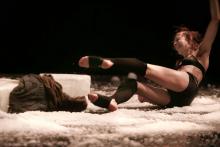
The name of this show means Position Parallel to the Floor (for the acronym in French Position Parallèle au Plancher). It describes itself as “circus.” I wonder if this is a new theater genre, the Circus of Pain.

Philippe Ménard has impressive dexterity at handling balls of ice that range in size from baseballs to bowling balls. Suspended balls of ice also plummet menacingly from the ceiling and smash on the floor at apparently random intervals, although I suspect that heated wires determine exactly when certain balls will drop. Ménard juggles the balls, rolling them along the body, but there is only so much contact with ice that the body can stand. At other times Ménard lies across a pile of snow in just a bra and panties, or sits on a block of ice. I wanted to shout, “Get off your block of ice!” The performance is very uncomfortable to watch. It is impossible to witness without cringing in discomfort.

Ménard uses ice as the medium for expressing that we are constantly changing. We have some control over this process, but in the end the physical elements that are our makeup will eventually defeat our will. Right down to the transformation he himself underwent in real life to change his sex from that of a man to a woman. At the end of the performance, Ménard steps out of the dress and bra, and removes the silicon stick-ons from his chest revealing that, despite his best efforts, the material of which he was made did not cooperate with his concept of himself. It is in intensely vulnerable moment.

I acknowledge the art and the message in this performance, but I can’t say that I enjoyed it.


PPP
Philippe Ménard - Non Nova, Francia
Teatro Montessori
28 de marzo 2010


El nombre de este espectáculo significa Posición Paralela al Piso. Se promociona como espectáculo de “circo”. Me pregunto si esto es un nuevo de género teatro, el Circo del Dolor.

Philippe Ménard tiene una destreza impresionante en su manejo de las bolas de hielo que varían en tamaño desde pelotas de béisbol hasta bolas de boliche. Otras bolas de hielo suspendidas precariamente caen del techo y se estallan contra el piso a intervalos aparentemente aleatorios, aunque sospecho que cables con un elemento de calefacción determinan con exactitud cuando determinadas bolas caerán. Ménard hace malabares con las bolas, las ruedan a lo largo del cuerpo, pero sólo su puede aguantar el contacto con el hielo hasta cierto punto. En otros momentos, se acuesta en una pila de nieve, vestido únicamente de un sostén y un panty, o se sienta en un bloque de hielo. Quise gritarle, "Levántate del bloque de hielo!" El espectáculo es muy incómodo de presenciar.

Ménard utiliza el hielo como medio para expresar que estamos en un proceso de cambio constante. Tenemos algún control sobre este proceso, pero al final los elementos físicos que nos componen eventualmente vencen a nuestra voluntad. Incluso en cuanto a la transformación que él mismo se hizo en la vida real, de cambiar su sexo de un hombre a una mujer. Al final del espectáculo, Ménard quita su vestido, el sostén, y los aplicables de silicona de su pecho y revela que, a pesar de sus esfuerzos, el material que le compone no concordó con su concepto de sí mismo. Es en el momento de intensa vulnerabilidad.

Reconozco el arte y el mensaje en esta espectáculo, pero no puedo decir que le disfruté.


Neva
Teatro en el blanco, Chile
Teatro Arlequín
29 March 2010


Playwrights like plays about the theater, just like authors like books about literature. Chilean playwright Guillermo Calderón brings us a play in which three actors, one of them portraying Anton Chekov’s widow Olga Knipper, rehearse, performs scenes, and provide a glimpse into the human relations backstage, as the St. Petersburg massacre of 1905 is unfolding outside. Contrast and crisis are inevitable. We live our little lives, have our little passions, perform our little parts, as larger forces shape the world around us. Is theater a bourgeois pastime? Is each little life insignificant? Maybe, but it is ours and it is the only one we have.

Calderón’s play is cunningly written and beautifully performed. Paula Zúñiga, Trinidad González, and Jorge Bécker show great versatility as they slip back and forth between formal rehearsal, scenes they are improvising for each other, and interacting as performers and individuals as opposed to characters. Often the transition is so seamless that the audience needs to take a beat to realize that the portrayal has shifted. Theater for theater-goers.


Neva
Teatro en el blanco, Chile
Teatro Arlequín
29 de marzo 2010


Los dramaturgos les gustan las obras de teatro sobre el teatro, al igual como los autores les gustan los libros sobre la literatura. Dramaturgo chileno Guillermo Calderón nos trae una obra en el cual tres actores, una quien representa la viuda de Anton Chejov, Olga Knipper, ensayan, realizan escenas, y ofrecen una vista de las relaciones entre actores tras escena, mientras que la masacre de San Petersburgo de 1905 se desenvuelva afuera. El contraste y la crisis son inevitables. Vivimos nuestras pequeñas vidas, tenemos nuestras pequeñas pasiones, realizamos nuestros pequeños papeles, mientras que fuerzas más grandes moldean el mundo que nos rodea? El teatro es un pasatiempo burgués? Cada vida es insignificante? Tal vez, pero es la nuestra, y es la única que tenemos.

El texto de Calderón es hábilmente escrito y eficazmente realizada. Paula Zúñiga, Trinidad González y Jorge Becker muestran una gran versatilidad mientras que cambian de papel entre el ensayo formal, las escenas que improvisan el uno para el otro, y su forma de interactuar como actores e individuos, dejando al lado sus papeles profesionales. A menudo la transición es tan perfecta que el público necesita un momento para darse cuenta que el papel ha cambiado. Es teatro para los amantes del teatro.

Sunday, March 28, 2010

Odisea Caótica de Israel y Haberos quedado en casa capullos de Colombia


Odysseus Chaoticus
Ish Theater, Israel
Compensar Auditorium
26 March 2010


A universal story told in a universal language: gibberish

Noam Rubinstein (Ody), Yolana Zimmerman (Penny/Penita), and Fyodor Makarov (Papa) portray an Italian man, his wife, and his elderly father in a high energy show that flips back and forth between the drudgery of everyday home life, and the adventures of Ulysses in Homer’s Odyssey, all done with a manic comic twist. Zimmerman as the Cyclops’ goat and Calypso was hilarious. Makarov tends to steal every scene, and was particularly good as Poseidon. Rubinstein brings us along on the journey with huge versatility. The performances were wonderful. Toward the end, a number of the adventures are compressed together and these don’t make much sense unless you are familiar with the Odyssey. These scenes could be cut without doing any harm to the play

The play uses universal gibberish “Italian” for the dialogue, intelligible to all speakers of Romance languages, although all of the songs are in English. The language convention reminded me of the skit “Una munda” from the show All in the Timing, performed at the 2006 Iberoamerican theater festival by Peepolykus Theatre of the UK. Like that performance, the Ish Theater production depends on timing to make the comedy work, and Rubinstein, Zimmerman, and Makarov carry the day with aplomb.

This was a funny little show that did not depend on special effects to make it succeed, just great performances, snappy timing, and funny quirky imagery. I laughed out loud.


Odisea caótica
Teatro Ish, Israel
Auditorio Compensar
26 de marzo 2010


Una historia universal contada en un lenguaje universal: galimatías

Noam Rubinstein (Ody), Yolana Zimmerman (Penny /Penita), Fyodor Makarov (Papa) representan un hombre italiano, su esposa, y su padre anciano en un espectáculo de alta energía que mueve entre la monotonía de la vida familiar cotidiana, y las aventuras de Ulises de La Odisea de Homero, con un toque cómico maníaco. Zimmerman, en los papeles de la cabra del cíclope y Calypso fue muy graciosa. Makarov roba cada escena, y fue particularmente divertido como Poseidón. Rubinstein nos lleva por el viaje con gran versatilidad. Las actuaciones fueron maravillosas. Hacia el final de la obra, una serie de aventuras están comprimidas y éstas no tienen mucho sentido a menos que uno conoce la Odisea. Estas escenas podrían ser recortadas sin perjudicar a la obra

El espectáculo utiliza un “italiano” de galimatías como lenguaje universal, inteligible para todos los parlantes de lenguas latinas, aunque las canciones están en inglés. Esta técnica me acordó de la escena “Una munda” de la obra Todos a su tiempo, que Peepolykus Teatro del Reino Unido presentó en el Festival Iberoamericano de Teatro en 2006. Al igual que este espectáculo, la producción de Ish Teatro depende del ritmo para realizar el efecto cómico, y Rubinstein, Zimmerman y Makarov logran este propósito con aplomo.

Es un espectáculo gracioso que no depende de efectos especiales para que tenga éxito, sino de sus grandes actuaciones, un ritmo ágil, y las imágenes singulares y graciosas. Me reí en voz alta.


Haberos quedado en casa capullos! (You Should Have Stayed Home Little Buds)
Asociación LODHE, Colombia
27 March 2010

In this play the audience is taken to the different settings where the play unfolds.

On one of the terraces of Rogelio Salmona’s graceful Torres del Parque buildings, Jimena Durán gives a speech in which she tells a little girl not to think with anyone else’s head. As an example of living by other people’s ideas, she graphically describes a violent scene in which everyone’s head has been removed from their bodies at school and people are trying to find their heads. The images she paints are horrifying, referring to blood, sex and violence, but the little girl to whom she is speaking is nonplussed. Admittedly no one ever really listens to anyone else (a theme that is repeated in the following scenes). The scene falls a bit flat.

The second scene takes place in a bar in La Macarena, a neighborhood that has gone much more upscale than when I lived there in 1991. A drunken woman (Patricia Tamayo) stirs at the bar and then begins her dialogue, reflecting on the “uselessness” of life, and her non-relationship with her parents. My critique of this scene is mainly the performance: Anyone so drunk as to be splashing her liquor all over the place should be having more difficulty getting the words out of her mouth. Her reflections are painful and these should have been much more difficult to voice. The scene would also have been more effective if there had been actual clients present at the bar.

The third scene was brilliantly done. The audience is taken to the living room of an apartment with windows looking out over the street. Outside a “street person” launches into a crazy diatribe about how each beating one gives or receives in life is a lesson. Carlos Gutiérrez was brilliant in the role, following passersby down the street as he continued with his discourse, and vaguely wandering around in the road getting in the way of the traffic. Having a city bus come down the road was a particularly nice touch by the director. Of course if it had been a real bus, the driver would have been leaning on the horn and hurling as much invective as the performer!

The man eventually wanders off and as we turn back from the window we find that a boy is seated in the living room reading a book (completely coincidentally, the boy Martín Fernández is one of my son’s classmates from school). The bathrobe clad father (Mario Duarte) comes down stairs and tells the boy (12) that tomorrow he will not go to school but that he will go out and work to get money so that he can have what he wants in life. The father continues with a violent, yet funny, story about a pony in the park where his parents would take him when he was a child.

Each of the four scenes makes references back to the others, picking up the common themes of violence, disappointment, futility, and the inability to communicate. The writing is dark and funny, but only the third and fourth scenes are really strong enough to stand alone.

It is an interesting conceit: Life is theater, and we are part of it and it is happening around us all the time. I am glad that I saw this performance, but I feel that the show needs to be tightened up a bit more.


Haberos quedado en casa capullos!
Asociación LODHE, Colombia
27 de marzo 2010


En esta obra el público es llevado a los diferentes lugares donde las escenas de la obra se desenvuelvan.

En una de las terrazas del conjunto de edificios Torres del Parque de Rogelio Salmona, Jimena Durán pronuncia un discurso en el cual instruye a una niña no pensar con la cabeza ajena. Como un ejemplo de vivir según las ideas de otras personas, ella describe gráficamente una escena violenta en la cual las cabezas de todo el mundo están desprendidas de sus cuerpos en la escuela, y la gente está tratando de encontrar la cabeza. Las imágenes que pinta son horribles, con referencias a la sangre, el sexo y la violencia, pero la niña no la pone mucha atención. Es cierto que nadie realmente escucha (un tema que se repite en las otras escenas). La escena queda un poco plana.

La segunda escena tiene lugar en un bar en La Macarena, un barrio que se ha vuelto mucho más de cachet que cuando yo vivía allí en 1991. Una mujer ebria (Patricia Tamayo) se levanta de su estupor sobre la barra y comienza su diálogo, una reflexión sobre la “futilidad” de la vida, y su falta de relación con sus padres. Mi crítica de esta escena es principalmente la actuación: alguien quien es tan borracha como para salpicar su trago por todo lado debería tener más dificultades para sacar las palabras de la boca. Sus reflexiones son dolorosas y estos deberían haber sido mucho más difíciles de expresar. La escena también hubiera sido más eficaz con la presencia de clientes reales en el bar.

La tercera escena fue excelente. El público entra en la sala de un apartamento con ventanas que dan a la calle. Afuera un “indigente” se lanza una diatriba sobre las lecciones de “las palizas” que uno da o recibe en la vida. Carlos Gutiérrez fue brillante en el papel, siguiendo a los transeúntes por la calle mientras que daba su discurso, y vagando en la vía, estorbando el tránsito. Su encuentro con un bus de transporte público fue un toque brillante del director. Por supuesto, si hubiera sido un bus real, el conductor habría pitado a la lata mientras lanzaba invectivas igual como el actor!

El hombre eventualmente divaga. Volteando la mirada hacia la sala, encontramos un niño sentado en un sillón leyendo un libro (por casualidad, el niño Martín Fernández es un compañero de curso de mi hijo). El padre (Mario Duarte), vestido de bata, baja las escaleras y le dice al niño (12) que mañana no irá al colegio, sino que saldrá a trabajar a ganar dinero para así hacer lo que quiere en la vida. Continúa con una historia divertida pero violenta de un caballo en el parque donde sus padres lo llevaba cuando era un niño.

Cada una de las cuatro escenas hace referencia a las otras, recogiendo los temas comunes de la violencia, la desilusión, la futilidad, y la incapacidad de comunicarse. El guión es de humor muy negro, pero sólo la tercera y la cuarta escena funcionan realmente bien.

La obra parte de una idea interesante: La vida es teatro, y nosotros hacemos parte de la obra que está sucediendo a nuestro alrededor todo el tiempo. Estoy contenta que vi a esta obra, pero creo que la dirección necesita unos ajustes.

Friday, March 26, 2010

Wow theater: Condición Aérea from Argentina and The Aluminum Show from Israel


Condición Aérea (Air Condition)
Brenda Angiel Aerial Dance Company, Argentina
Coliseo El Campín
24 March 2010


Maybe an awareness that they live "upside down" on the lower part of the globe, is part of the Argentinean sensitivity. What if we were no longer consigned to the ground by gravity? My children have often been seen going around the house, stuck to the walls because they are playing that gravity has shifted. It is that same spirit of playfulness that infuses Condición Aérea.

Perspective shifts constantly in Condition Aérea. Suspended from above, the dancers perform with their feet on the back wall of the stage. This means that the audience is viewing them "from above." Equally, the dancers might be facing the audience straight on, or else upside down. Suddenly orientation is very relative. Freed from the constraints of gravity, the dancers perform a soaring tango. Fly on the wall: a single dancer moves along the wall, as an image of herself is projected in close up and at a different angle. The most compelling performances had some dancers on the floor, interacting with dancers who were suspended. The final dance had four performers moving together in the air, while the choreography was projected around them, turning the four into eight and sixteen in a kaleidoscope image. It was a very effective use of multimedia in dance.

Aerial performance seems to be part of the Argentinean theater tradition. In 2006 I saw Villa Villa by De La Guarda Theater (part theater, part circus, part rave), and in 2007 I saw the show Fuerza Bruta , also from Argentina. Both of these groups make extensive use of aerial dance. I would go see either of these groups again in a flash. In contrast, Condición Aérea is a good show but not a great show. It is interesting but the performance was a bit jerky and it is somewhat limited in what is proposes. If you go, buy the cheaper seats in the first balcony because the stage is very high and you won't see properly if you have the expensive front row seats.


Condición Aérea
Compañía de Danza Aérea Brenda Angiel, Argentina
Coliseo El Campín
24 de march 2010


Tal vez la conciencia de que viven "al revés", en la parte inferior del globo, hace parte de la sensibilidad argentina. ¿Qué pasará si ya no fuéramos pegados a la tierra por la gravedad? A veces mis hijos andan por la casa, pegados a las paredes porque están jugando que la gravedad se ha desplazado. Es ese mismo espíritu juguetón que infunde Condición Aérea.

La perspectiva cambia constantemente en Condición Aérea. Suspendidos desde arriba, los bailarines muevan con los pies sobre la pared trasera del escenario. Esto significa que el público está viendo el espectáculo "desde arriba". Igualmente, los bailarines pueden estar de cara frente al público o colgados al revés. La orientación es muy relativa. Liberados de las limitaciones de la gravedad, los bailarines interpretan un tango que vuela. Como un mosca en la pared: una bailarina se mueve sola en la pared, mientas una imagen de ella se proyecta en primer plano y desde un ángulo diferente. Las coreografías más interesantes tuvieron algunos bailarines en el piso, interactuando con bailarines suspendidos. La danza final era cuatro bailarines moviendo en el aire, mientras que una imagen de la coreografía fue proyectada en torno a ellos, convirtiendo los cuatro en ocho y dieciséis, en una imagen de caleidoscopio. Fue un uso muy eficaz del elemento multimedio en la danza.

Danza aérea parece ser parte de la tradición teatral argentina. En 2006 vi Villa Villa de De La Guarda Teatro (en parte teatro, en parte circo, en parte rave), y en 2007 vi el espectáculo Fuerza Bruta, también de Argentina. Ambos grupos hacen uso extensivo de la danza aérea. Volvería a ver cualquier de estos grupos sin vacilar. En contraste, Condición Aérea es bueno, pero no es un gran espectáculo. Es interesante, pero falta pulir un poco la ejecución y es algo limitado en lo que se propone. Si vas a ver la obra, compre los puestos económicos en el primer balcón, en lugar de la platea porque el escenario es muy alto y no se alcanza ver bien desde los puestos costosos delanteros.


The Aluminum Show
Dollbeat Productions, Israel
Palacio de los Deportes
25 March 2010


The first major influence that is obvious in this show is the Swiss group Mummenschanz: performers inside folding Mylar tubes interact as beings that look like industrial air ducts. The show also has nods to Stomp Out Loud, Mayumana (also from Israel, saw them in Bogota in 2007), militaristic overtones suggest the influence of the Kibbutz Contemporary Dance Company (Dollbeat Productions director Ilan Azriel has worked with KCDC; their show Ekodoom, at the last theater festival, was also excellent), singing baby aluminum slugs (a little bit of Flushed Away), and a funny futuristic aluminum fashion show.

The Aluminum Show is cool, space age, high energy, fun entertainment. There is no message, it is just superb performance making creative use of unusual materials. Highly recommended for all ages. I would go see it again, it's that good. Hurry to see this show; it only runs until 28 March. For this show it is worth it to pay the extra money and buy the more expensive ground level seats.


The Aluminum Show
Dollbeat Productions, Israel
Palacio de los Deportes
25 de marzo 2010


La primera influencia evidente en este espectáculo es del grupo suizo Mummenschanz: los artistas dentro de tubos plegables de Mylar interactúan como seres que parecen a conductos industriales de aire. El espectáculo también hace guiños a Stomp Out Loud, Mayumana (también de Israel, que vi en Bogotá en 2007), aspectos militaristas que sugieren la influencia de la Compañía de Danza Contemporánea del Kibutz (Ilan Azriel , director de Dollbeat Productions, ha trabajado con el grupo Kibutz; cuyo espectáculo Ekodoom en el festival de teatro pasado también fue excelente), babosas bebé de aluminio cantando (un poco de Lo que el agua se llevó), y un divertido desfile de moda futurista de aluminio.

El Show de Aluminio es chévere, futurista, de alta energía, y es entretenimiento divertido. No hay ningún mensaje, es sólo un espectáculo excelente que hace uso creativo de materiales inusuales. Altamente recomendado para todas las edades. Me gustaría ir a verlo de nuevo, así es de bueno. Date prisa para verlo, está en cartelera únicamente hasta el 28 de marzo. Para este espectáculo vale la pena pagar un poco de dinero extra y comprar puestos en la platea.

Monday, March 22, 2010

Cuttlas anatomía de un pistolero


Cuttlas anatomía de un pistolero
Producciones Essencials y Acetato Teatro, Cataluña
22 March
Compensar
Véase la versión el español en la parte inferior de la página.

Nowadays the audience for children’s theater is demanding and sophisticated. Having two children, I’ve attended my fair share of children’s theater and I resent it when it fails to deliver an intelligent, thoughtful performance. Plus children’s audiences have become accustomed to the world of Pixar, Wallace and Gromit, even Disney, and we expect some subtle elements that speak to the adults who have accompanied the children. Don’t get me wrong, children’s humor can be great. For example, I love the work of Argentine writer-performer Luis Pescetti, and the Bogota theater companies La Gata and La Libélula Dorada. I have plenty of tolerance for experimental theater that is visually or musically interesting. The technical elements don’t need to be impressive if the play tells a good story. But the series of vignettes that make up Cuttlas anatomía de un pistolero does not add up to any sort of narrative, and the overall effect is simply a letdown.

The children in the audience were not held captivated; there was a lot of shuffling and commenting in the audience, and they were not interacting with the characters onstage. The parents did not laugh at the jokes, which is not a good sign.

There is beauty in the simple outline figures used for the characters. They immediately suggest animation, or Pablo Picasso’s line drawings. The live music, including a honky-tonk western piano man, and an intimate ukulele moment, was good, but it was not enough to recommend the play.

Director Sergi Pons and his theater company work in the field of object theater (bringing inanimate objects to life), probably the best example of which is the Swiss group Mummenschanz that I have seen in two previous theater festivals. Save your money and your time and go see Mummenschanz if they come again, rather than this group.


Cuttlas anatomía de un pistolero
Producciones Essencials y Acetato Teatro, Cataluña
22 marzo
Compensar

Hoy en día el público para el teatro infantil es exigente y sofisticado. Con dos hijos, he asistido a una buena cantidad de teatro para niños y me molesta que cuando la obra no es de altura, inteligente y bien pensado. El público para el teatro infantil se ha acostumbrado al mundo de Pixar, Wallace y Gromit, e incluso Disney, y esperamos elementos sutiles que hablan a los adultos quienes acompañan a los niños. No me malinterprete, el humor infantil puede ser genial. Por ejemplo, me encanta el trabajo del escritor-artista argentino Luis Pescetti, y las compañías de teatro bogotanas La Gata y La Libélula Dorada. Me encanta el teatro experimental, cuando es interesante al nivel visual, musical, o en sus planteamientos. Acepto que los elementos técnicos no están impresionantes si la obra cuenta una buena historia. Pero la serie de viñetas que componen Cuttlas Anatomía de un pistolero no se suma en una narrativa, y el efecto global es decepcionante.

Los niños asistentes no quedaron encantados, había mucha inquietud y bulla entre ellos, y no estaban interactuando con los personajes en el escenario. Los padres no se ríen de los chistes, algo que no es una buena señal.

Hay belleza en la simplicidad de delimitar los personajes como dibujos escuetos. Sugiere la técnica de animación o los dibujos de Pablo Picasso. La música en vivo, incluyendo un piano honky-tonk estilo viejo oeste, y un momento íntimo de ukelele, era buena, pero no fue suficiente para recomendar la obra.

El director Sergi Pons y su compañía de teatro trabajan en el campo de teatro de objetos (en el cual dan vida a objetos inanimados). Probablemente el mejor ejemplo de este género es el grupo suizo Mummenschanz que he visto en dos festivales de teatro anteriores. Ahorre su dinero y su tiempo y vayan a ver Mummenschanz en lugar de este grupo.

Sunday, March 21, 2010

Samsara, Compañía Víctor Ullate Ballet


Samsara
Víctor Ullate Ballet Company, Spain
21 March
Teatro Colsubsidio

Véase la versión el español en la parte inferior de la página.

TranscenDance

Samsara means “to flow together.” It refers to the concept of reincarnation in India’s philosophical traditions, and the capacity of human beings to free themselves from that cycle through illumination or nirvana, which is the absence of longing and suffering. Achieving nirvana is pretty much an endless cycle for we imperfect humans.

The show begins with the dancers in semi-darkness, performing a tai chi-like choreography as images of the most horrific historical atrocities are projected on a screen behind them. The warning is clear: humankind has tremendous capacity for harm and destruction, but it also has the capacity to transcend.

The Víctor Ullate Ballet Company emphasizes technical classical ballet training and the dancers show off this training to good effect, but the choreographies break out of the traditional mold and explore different aspects of expression through movement, in this case with strong influence from the Asian martial arts. References to prayer, love, chanting, drumming, tai chi, martial arts are all used in Samsara as vehicles for transcendence. It is a highly successful mix of traditions.

Some highlights from the performance: A couple whose synchronization and understanding is so profound that sometimes they appear to meld into a single organic being. A dancer who looks like a Buddhist initiate in his robes, whose dance is so spiritual that you feel uplifted. Burqa clad women huddle together, fearful; each one approaches the light and receives it in her hands. There is beauty in the moment, but as the dance continues darker aspects are revealed in the harsh punishments meted out for daring to stray from the dictates of Islamic law.

In the costuming color is used to emphasize vitality and exuberance. Black and gray reflect a lack of illumination. The music is sometimes light and soaring, at other times deep and percussive, and sometimes strange and beautiful chanting. Each scene begins with a quote that sets the tone, although some of the dances were easier to relate to the quote than others.

Is nirvana reached? The final scene has each dancer come forward on the stage and place a single white rose in a row. It is a small gesture of hope and beauty. A peaceful moment before the human dance can begin again in its hopes and misguided clumsiness. Humankind is still working on it. Samsara, however, achieves a state of grace.


Samsara
Compañía Víctor Ullate Ballet, España
21 March
Teatro Colsubsidio

TrascenDanza

Samara significa “fluir juntos.” Hace referencia al concepto de la reencarnación en las tradiciones filosóficas de la India, y a la capacidad de los seres humanos para liberarse de este ciclo mediante la iluminación o nirvana, que es la ausencia del deseo y el sufrimiento. Alcanzar nirvana es prácticamente un ciclo sin fin para nosotros, los seres humanos imperfectos.

El espectáculo comienza con los bailarines en la penumbra, realizando una coreografía que parece tai chi, mientras imágenes de las atrocidades más horribles de la historia se proyectan en una pantalla detrás de ellos. La advertencia es clara: la humanidad tiene una gran capacidad para el daño y la destrucción, pero también tiene la capacidad de trascender.

La Compañía Víctor Ullate Ballet hace énfasis en la técnica del ballet clásico y los bailarines lucen su formación, pero las coreografías rompen con el molde tradicional y exploran diferentes aspectos de la expresión a través del movimiento, en este caso con una fuerte influencia de las artes marciales asiáticas. Referencias a la oración, el amor, el canto, la percusión, el tai chi, y las artes marciales se usan en Samsara como vehículos para la trascendencia. Es una mezcla muy exitosa de tradiciones.

Algunos aspectos destacados de la obra: Una pareja cuya sincronización y comprensión es tan profunda que a veces parece fundirse en un solo ser orgánico. Un bailarín quien parece a un budista en entrenamiento, cuyo baile es tan espiritual que lleva al espectador en alto. Mujeres vestidas de burqa apiñan juntas, temerosas; cada uno se acerca a la luz y la recibe en sus manos. Es un momento de belleza, pero el baile continúa y los aspectos más oscuros se revelan en los duros castigos impuestos por atreverse a apartarse de los dictados de la ley islámica.

En el vestuario de color se utiliza para enfatizar la vitalidad y la exuberancia. El negro y el gris reflejan la falta de iluminación. La música es a veces ligera y alegre, en otros momentos es contundente y de percusión, y a veces es un extraño y bello canto. Cada escena comienza con una cita que marca el tono, aunque algunas de las danzas son más fáciles relacionarse con la cita que otras.

Se alcanza el nirvana? En la última escena cada bailarín se acerca a la parte delantera del escenario y coloca una sola rosa blanca en una fila. Es un gesto pequeño de esperanza y belleza. Es un momento de tranquilidad antes que la danza humana puede empezar de nuevo, en su esperanza y torpeza. La humanidad todavía está en su búsqueda. Samsara, sin embargo, alcanza un estado de gracia.

Saturday, March 20, 2010

The Battle of Stalingrad / La batalla de Estalingrado

Véase la version el español en la parte inferior de la página.


The Battle of Stalingrad
Tbilisi Marionette Theatre, Georgia
20 March, Teatro Libre del Centro


A Matter of Scale

Sometimes the best way to deal with an event that is enormous, is to make it small. This is the approach taken in portraying the Second World War battle for Stalingrad that was fought between the German and Soviet Armies, a clash that left over 3 million dead. Working on a miniature scale makes it possible to address events that took place on a large scale. Some of the striking images used to convey this effect were sheets of helmets moving by as if on a conveyer belt to suggest an endless army; two turntables on which different elements of scenery are placed as we hear the unceasing clackety-clack of a train rushing over the rails; a tattered and destroyed Kremlin tucked away at the back of a scene.

Asking the audience to suspend its disbelief in order to allow the story to be told through puppets makes it possible to break over conventions too. The characters include a spirit who restores a character to life (even though he warns that the other will suffer bitterly), a pair of horses whose love is interrupted and lost because of the war, and an ant lamenting the loss of a daughter. The latter is one of the play's most powerful moments: No one mourns the loss of a crushed ant, except that ant's own family. In war, we are all merely ants crushed under the exorable forces of someone else's imperatives. Nor, for that matter, can the horses be taken literally, and that is not a problem within the play's logic. Some of the human characters were less clear.

Sometimes I felt that the scenes lacked context elements for understanding. This could have been the result of a lack of familiarity with the events, or might also have been a translation problem. When I was deciding which plays I would see during the theater festival, I looked at a number of reviews. Sometimes the reviews quoted dialogue from performances given in English. The English translations that I saw looked a lot better than the Spanish subtitles that were provided tonight.

In terms of technical elements, the lighting was subtle and impeccable. Sound was excellent (the group uses a prerecorded soundtrack rather than delivering dialogue live.) The visual elements used to set the scenes were creative and evocative, striking just the right balance between realism and expressionism. The technical expertise of the puppeteers was excellent. They are always visible to the audience and yet they do not distract, and sometimes they are part of the action such as laying a table while waiting for a person to arrive home, or giving a burial to the dead.

The play was at its best in its most intimate moments. The lone ant. A painting of a bedroom and a bed with two pillows, and a single figure who slowly raises a handkerchief to her eyes. It is hard to get a feeling of the full magnitude of the death and destruction, but the plays conveys the sense that no one was left untouched by this war.


La batalla de Estalingrado
Teatro Estatal de Marionetas de Tbilisi, Georgia
20 de marzo, Teatro Libre del Centro


Trabajando a escala

A veces la mejor manera para tratar un evento que es enorme, es de hacerle pequeño. Este es el enfoque adoptado para presentar la batalla que los ejércitos alemán y soviético libraron sobre Estalingrado en la Segunda Guerra Mundial, un enfrentamiento que dejó más de 3 millones de muertos. Trabajando en escala de miniatura permite abordar acontecimientos que tuvieron lugar en gran escala. Algunas de las imágenes impresionantes utilizadas para transmitir en esta sensación fueron bandejas de cascos que movían como sobre una cinta transportadora para sugerir un ejército infinito, dos platos giratorios sobre los cuales se colocaban diferentes elementos del paisaje acompañado del sonido incesante del clac-clac de un tren corriendo sobre los rieles, un Kremlin roto y destruido medio escondido en la parte posterior de la escena.

Pedir al público de suspender su incredulidad para permitir que la historia sea contada a través de títeres permite romper con otras convenciones también. Los personajes incluyen un espíritu quien restaura la vida a otro personaje (y le advierte que sufrirá amargamente), un par de caballos, cuyo amor se interrumpe y se pierde a causa de la guerra, y una hormiga lamentando la pérdida de una hija. Esta última es uno de los momentos más conmovedores de la obra: Nadie llora la pérdida de una hormiga aplastada, con excepción de su familia. En la guerra, todos somos simplemente hormigas aplastadas por las fuerzas exorables de imperativos ajenos. Los caballos tampoco se pueden considerar literalmente, y eso no es un problema dentro de la lógica de la obra. Algunos de los personajes humanos fueron menos claros.

A veces me sentí que algunas escenas carecían de elementos para entender el contexto. Esto podría haber sido consecuencia de una falta de conocimiento de los hechos, o tal vez fue un problema de traducción. Cuando estuvo tomando las decisiones sobre cuales obras iba ver durante el festival de teatro, revisé las críticas. A veces las críticas citaban diálogo de presentaciones en inglés. Las traducciones al inglés que vi parecían mucho mejores que los subtítulos en español que vi esta noche.

En cuanto a los elementos técnicos, la iluminación fue sutil e impecable. El sonido fue excelente (el grupo utiliza una banda sonora pregrabada en lugar de diálogo en vivo.) Los elementos visuales utilizados para establecer las escenas fueron creativos y evocativos, con un equilibrio justo entre el realismo y el expresionismo. El desempeño técnico de los titiriteros fue excelente. Ellos siempre son visibles para el público y sin embargo no distraen, y a veces hacen parte de la acción: por ejemplo poniendo una mesa a la espera de una persona para llegar a casa, o dando sepultura a los muertos.

La obra se destacaba en sus momentos más íntimos. La hormiga solitaria. Una pintura de una alcoba con una cama de dos almohadas, y la figure de una mujer solitaria quien lleva lentamente un pañuelo a los ojos. Fue un desafió comunicar el concepto de la magnitud de la muerte y la destrucción, pero la obra logra transmitir la sensación que nadie se queda al margen de la guerra.