Showing posts with label review. Show all posts
Wednesday, May 27, 2015
Deeply Disturbing
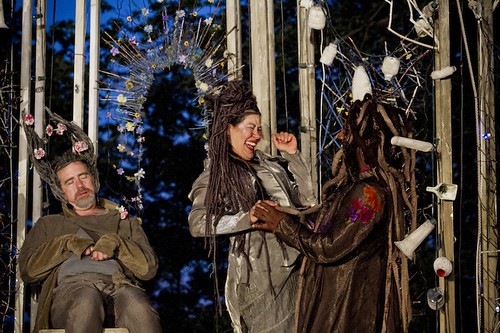
Director Chris Abraham's production of The Taming of the Shrew is now in previews at Stratford (the production opens officially on June 5). It is looking very polished already and it is so fresh that it smarts.
The Taming of the Shrew is a difficult play to think about producing nowadays. The story line of how a man goes about taming his unruly wife is not exactly a paragon of gender equality. Chris Abraham is fearless in his handling of this highly problematic text. The director's first recourse is distancing. As the audience files into the theatre, some of the actors, still in their street clothes, are on the stage and chatting to members of the audience. Tom Rooney, who plays Tranio, remarks that he has been performing Shakespeare for years but this is the first time he has done so in Elizabethan dress. The actor who plays Kate is welcomed onstage and introduced by name: "Here comes Deb Hay!" All of this is a reminder to the audience: This is a play.
The action begins with an interruption by "audience member Christopher Sly," who objects to this lack of suspended disbelief. He rails against being shown the visible underpinnings of theatre, noting that he should not be surprised at this, "coming from the director of My Big Fat Gay Wedding," a reference to director Chris Abraham's production of A Midsummer Night's Dream, last year (http://noessinomivida.blogspot.ca/2014/06/stratford-1-nothing-was-what-i-expected.html), which was so flamboyantly gay that it would be inconceivable to accuse Abraham of upholding conventional gender roles. The Christopher Sly introduction is Shakespeare's creation, an indication that The Bard himself was aware that he was dealing with some seriously problematic sexism and he would be well advised to prime the audience with a reminder that what is said should not necessarily be taken at face value.
First of all, in the logic of the time in which the play is set, a woman was chattel. She was the negotiable property of her father and husband. Petruchio (Ben Carlson) is broke and he needs a wife who has a substantial dowry. He knows that Katherina (Deborah Hay) is rich and he makes it clear that his intention is to break her headstrong character and enjoy her fortune.
Petruchio gets off to a pretty good start. He is as sharp tongued and quick-witted as Katherina and the two can banter like nobody's business. Kate does appreciate that as quickly as she can deliver her zingers, he comes back with a retort. He does succeed in winning some esteem from her, but that promise of equality crumbles after he marries her (having lied to her father, claiming that she agreed to the marriage). The wedding is a mockery. He shows up late (leaving her to contemplate the possibility that she is being humiliated by being stood up at the altar), wearing a mishmash of odd clothing and riding on a half-dead horse.
Petruchio takes Kate home and implements his plan to break her through starvation, sleep deprivation, forced marches, and being made to wear her wedding dress, the symbol of purity in love, until it is ragged and filthy from being dragged through the mud. These deprivations he enacts "in the name of love," protesting that the food, the bed, the place, the new clothing are "not good enough for her." It is calculated manipulation on his part, and Petruchio voices his protestations violently and irrationally, making Kate doubt his sanity and fear what else he might put her through if she does not acquiesce. So finally, acquiesce she does.
In his plan, even an act of love, a kiss, becomes a form of debasement. Three times in the play, Petruchio asks Kate to kiss him. The first two times, she refuses, explaining that she would be ashamed to do so in the street (proper ladies of the time did not engage is public displays of affection). The third time he asks her to kiss him is at the end of the final scene, following her declaration of submission. In the context of the play, it is the ultimate debasement: she is being made to humiliate herself in front of her father and sister and neighbours.
The ending is dark. This is a Shakespearean comedy, so everyone gets married at the end (Kate and Petruchio, Bianca and Lucentio, the widow and Hortensio) but what kind of contract is this marriage? At the banquet to celebrate the marriages, a test of obedience is set and the women are summoned to come to their husbands. Only Kate obeys, and gives a speech about wifely duty. Petruchio gloats and points to his triumph in taming his wife. The characters onstage listen with astonishment and unease. Kate has entered into Bluebeard's bargain: her husband will care for and protect her so long as she obeys him. If she fails to obey, her very life could be forfeit. She is married to the insane manipulator and she will stay because she has no means to support herself. It is doubtful that her father would step in to help her, having finally married her off to a man who can keep her quiet.
The relationship between Kate and her father Baptista is not discussed at length in the play. Baptista dotes on his younger daughter Bianca, and he is aware that Katherina is a hellion. The unspoken question is what turned Kate into such a hellion in her relations with men? The audience is left to speculate on this. Kate and Bianca's mother is missing from their lives (presumed deceased). Was it the lack of a mother's love and influence that made Kate into what she is, or did something more insidious happen to her? Director Abraham does not explore the implications but allows audience members to ask themselves disturbing questions. The sense of unease is created without being explicit.
This production is conveyed with wit, social commentary, and a profound sense of danger. Laughter at the clever repartee gives way to horror. Petruchio is not a bon vivant, he is a manipulative psychopath. Starvation, sleep deprivation, defilement, public humiliation, and repeated reminders that she is mere chattel… this play is no longer funny and it is a poignant reminder that not that long ago women were not entitled to rights or property. It is deeply disturbing and for all the right reasons.
***
Saw three more productions during this trip to Stratford.
The Sound of Music. Creative set changes and great singing kept this somewhat wooden production alive. It was fun, it was competent but not surprising.
The Adventures of Pericles (Prince of Tyre). Like Odysseus, Pericles must journey and this production is all over the map: the people of Tyre are in Victorian dress, the people of Tarsus are in Elizabethan dress, the goddess Diana and her acolytes in Ephesus are decked out in some sort white habit that could be from the future or the past. Diana and her gang also act as Greek chorus, narrating where Pericles has landed and what has befallen him on the way. By the end of the play I was exhausted but not because of emotional intensity or engagement. Tyresome.
Hamlet. Passionate, intense, every line was laden with meaning and wordplay. This production deserves a review of its own.
Wednesday, August 28, 2013
Stratford Festival 2013: Four Plays in Three Days

Othello, 8:00 p.m. Thu 22 Aug 2013, Avon Theatre
An Intimate Journey Into Despair
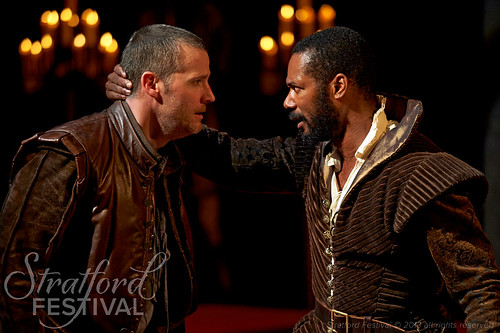
This production of Othello was simple and intimate. Shakespeare's story of ambition, love, and jealousy comes to life in the capable hands of director Chris Abraham with Dion Johnstone as Othello, Bethany Jillard as Desdemona, and Graham Abbey as Iago who puts the action into motion by planting the seeds of jealousy in Othello's brain and arranging the fall of anyone who might stand in the way of his ambition. This production was not about raging jealousy but about intimate despair so profound that it has crowded out any possibility of seeing the truth.
The staging is lovely in its utter simplicity. A rotating raked stage serves to make the transitions from one scene and setting to the next, along with images projected as shadows and windows that open in the wall. The translucent curtains that surround Desdemona's bed partly obstruct the view as Othello kills her, which both serves to buffer the graphic violence and reminds the audience that Othello is not seeing the whole picture. A shifting tilted platform, revolving feelings, shadows of doubt, and unexpected windows, and obstructions that allow one to see and yet not see clearly, echo the thematic elements within this play. Well done.

Tommy, 2:00 p.m. Fri 23 Aug 2013, Avon Theatre
See Me, Feel Me
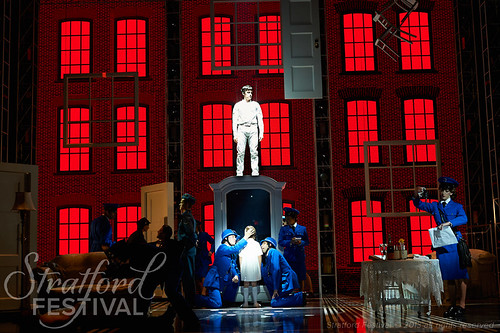
I have to say it: Peter Townshend's lyrics suck. Tommy isn't much of a story and the lyrics are pretty much bereft of poetry, poignancy, wit, or social commentary. So what is left? Great staging. Director Des McAnuff (loved his Twelfth Night in 2011) and set designer John Arnone make brilliant use of projected scenery to replace what would once have been painted backdrops. It wasn't gimmicky, it was excellent use of imagery and symbolism to give a feel for the spirit of times in which the story unfolds. I particularly liked the use of the black and white camera images that are projected as Tommy is being interviewed on television. As to the plot line and universal message: Don't commit murder in front of your children; don't leave them with funny uncles; and don't bestow messianic adoration on random prodigies.
I saw it but didn't feel it.

Fiddler on the Roof, 2:00 p.m. Sat 24 Aug 2013, Festival Theatre
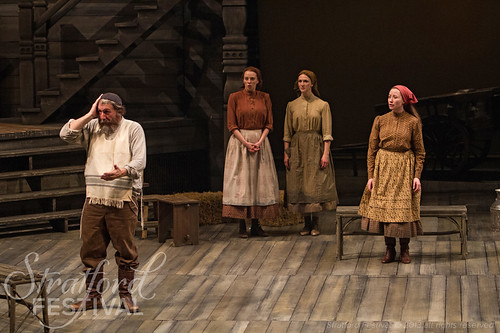
This story of how tradition, modern values, political forces, culture, religion, familial love and loyalty clash and resolve remains as relevant and as universal now as it ever was. The music is engaging, the lyrics are both playful and poignant. Fiddler on the Roof is a masterpiece of musical theatre and this rollicking production has plenty of life and exuberance.
On the downside, all of the performers in the mature adult roles appear to be too young. The fake beards aren't convincing enough. Scott Wentworth as Tevye is very good but lacks a certain gravitas. Kate Hennig as Golde doesn't bring quite enough weight to the role. Maybe she was saving her strength in this matinée performance, because she was excellent in the evening as the Nurse in Romeo and Juliet (see below). Hat's off to dancers Matt Alfano, Matthew Armet, Galen Johnson, and Julius Sermonia, who also appeared in Tommy. The versatile dance crew handled the different styles brilliantly.
For all the joking and playfulness, the message is serious at heart. As the characters leave the town of Anatevka at the end of the play, there is a sense of hope that their optimism and fortitude will allow them to start their lives anew. There is also a sense of foreboding, borne out by history, that they will never return to their home town and their way of life is over. The story of Fiddler on the Roof is as classic as it is modern and this production had plenty of heart.

Romeo and Juliet, 8:00 p.m. Sat 24 Aug 2013, Festival Theatre
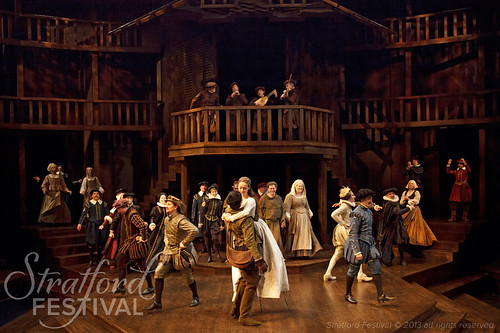
Director Tim Carroll and set designer Douglas Paraschuk have recreated a vision of how the Elizabethan theatre looked for this period production (reproduction) of Romeo and Juliet. The wooden stage with its balconies looks just like the model of The Globe Theatre that I remember seeing in high school. The musicians who provided the accompaniment to the performance were playing in the balcony as the audience began to take their seats. The performance began with an added prologue, written in verse à la Shakespeare, explaining that the house lights would be kept on to recreate the afternoon light in which the show would have been performed at an outdoor theatre in Shakespeare's time. Costuming was period-perfect.
Nowadays the main obstacle in performing Shakespeare is how to make it accessible to the modern audience. This production was no exception. It is language-dense. There is a lot of talking to explain who everyone is and to set the stage for the conflict to come. When all of the characters are dressed in similar style clothing and colour palate, it doesn't help. Characters such as Mercutio and the Nurse engage in a lot wordplay and the characters to whom they are speaking laugh and respond with glee, but my modern ears missed the jokes. It took a good 15 minutes to warm up to the production in that sense.
Once I had my ears suitably pointed back in time, I began to really enjoy the performances. Sara Topham as Juliet was beautifully smitten and not too sappy. Daniel Briere as Romeo conveyed the intensity of single-minded teenage pursuit. Kudos to Kate Hennig as Nurse, the single strongest character portrayal on the stage. I was delighted to see Antoine Yared in the cast, having been a fan of his work with Montreal's Repercussion Theatre. He plays Juliet's parent-sanctioned suitor Paris. It isn't much of a role, and he discharged it fairly woodenly, which was disappointing in consideration of the dynamic actor that I know him to be.
Romeo and Juliet remains a beautiful piece of theatre but it is a challenge for the modern audience.

A Midsummer Night's Dream, Repercussion Theatre, Thu 25 July 2013, Pine Beach Park, Dorval
For comparison's sake, A Midsummer Night's Dream, this year's Shakespeare-in-the-Park production by Montreal's Repercussion Theatre had all the elements of living, relevant theatre. What Repercussion Theatre lacks in budget and slickness it makes up for in energy and commitment to the roles. The outdoor setting, to which people bring picnics, lawn chairs, dogs and children, provides a sense of community. Repercussion Theatre's A Midsummer Night's Dream is a wild romp in the woods that lends itself to outdoor theatre in a way that Othello's private emotional turmoil and introspection might not. And try as Stratford may to recreate the experience of Elizabethan theatre with its production of Romeo and Juliet, it is hard to overcome the distance that is created by the awareness of the formal theatre setting.
Repercussion Theatre stays true to the purpose of bringing the theatre to the people and performing Shakespeare in a way that makes it as relevant now as it was when it was written. This group continues to impress me.
Sunday, May 26, 2013
A Karmic Encounter and The Book of Mormon
The Toronto run for The Book of Mormon at the Princess of Wales theatre sold out shortly after tickets went on sale. You can still buy tickets if you are willing to pay exorbitant prices to resellers (read scalpers).
The Lottery
The rest of us who aren't willing/able to shell out a couple of hundred bucks for tickets would be out of luck were it not for the Ticket Lottery. At 5:30 every afternoon, eager theatre-goers have half an hour to register for the 6:00 daily draw to win the right to buy a pair of tickets at the cost of $25 each. The conditions are: 1. One entry per person per day; 2. Before putting the ballot in the box, you have to register your name and ID at the desk. 3. The entrant and the other person who will attend the performance must be present at the draw. 4. The tickets must be paid in cash only. Lori suggested that we arrive at the theatre at 5:30 and enter the draw. She was particularly enthusiastic because I tend to win things. It is true. For reasons unknown, the universe tends to give me presents. I win random contests more often than would be expected, statistically speaking.
Chronically Late
I arrived at the theatre at 5:40 and registered for the draw. Lori was supposed to meet me there. Those of us who know and love Lori, are aware that she chronically tends to run a bit late for everything. This was aggravated by the fact that she was coming from her office in Etobicoke located in the far reaches of northwest Toronto, just before you hit Edmonton. As the 6:00 deadline loomed, I started looking around for someone else who appeared to be waiting for their equally tardy theatre partner to arrive.
A Brief Marriage of Convenience
John approached me. He wanted to get tickets to take his girlfriend, whose name coincidentally is Leslie, for her birthday. She wasn't with him, seeing as this was meant to be a surprise. We agreed that if his name were drawn, I would go to the box office with him as the partner and he would keep the two tickets. If my name were drawn, he would go with me and I would keep the two tickets. I forewarned John that I only had $47 in my wallet and I'd need to borrow money from him if I my name came up.
The Universe Smiles
I did win the drawing. John, not especially pleased because he realized that by accompanying me he would then forfeit his own chance to win, went into the box office to claim the tickets with me, and loaned me the necessary $3. Because these tickets are supposed to be non-transferable, they put amusement park-style wristbands on each of us which we would have to show, along with the tickets upon entry to the performance.
Lori on the Scene
Lori arrived just as we went outside again. I was all excited and jumpy and Lori couldn't quite figure out what was going on and why some slightly miffed guy wanted $3 from her. We went into Tim Horton's where we got coffee and borrowed a pair of scissors at the cash and carefully cut off John's wristband underneath where the closing tab overlapped. Lori paid John the $3 I owed, and we explained what had just transpired. John, who goes by the name John Karma, offered to buy the tickets from us but we weren't interested in selling. He was disappointed but very nice about. It turns out that he wanted the tickets not to take a current girlfriend, but a former one. A brief discussion about karma, kindness and caring ensued. It is good to continue to have a caring relationship with someone who is no longer your partner, but there is a point when you have to take steps to care for the health of your own heart when feelings are not reciprocated.

The Book of Mormon
The play has been a smash hit. So does it live up to the hype?
The Book of Mormon, by Matt Stone and Trey Parker the creators of South Park, in conjunction with Robert Lopez, is fabulously funny once you get over the initial "holy crap" shock at the blatant irreverence.
In brief synopsis, the plot tells the story of Elder Price, a young Mormon with a very high opinion of himself, who is paired up with the much less couth Elder Cunningham to be dispatched to spread the word of the Book of Mormon in Uganda, which is nothing like the place Price hoped to be posted: Orlando.
Price becomes discouraged as Cunningham struggles for a way to make the teachings of the Book of Mormon relevant to the Ugandan villagers, who are more worried about AIDS and the local warlord who wants to impose female circumcision than about the promises of some foreign religion. In order to get the story of the Book of Mormon across and sex it up a bit, Cunningham turns to the imagery familiar to all lone bookish nerds: Star Wars, Star Trek, the Lord of the Rings, and a bit of Pirates of the Caribbean thrown in for good measure. Exuberantly he incorporates the images of the sci-fi and fantasy world into his retelling of the Book of Mormon, and creates a story to which the people can relate, notwithstanding that it bears precious little resemblance to the original scripture.
Alien people, in a foreign land, preaching a book that is equally far-out, this show had all the potential to slip into snide mocking and derision. But what could have been a brutal slam on an eccentric religion gets a humanizing treatment. The self-centered Price gets his comeuppance. Cunningham finds strength and creativity when he realizes that, beyond evangelizing, his job is to help the people deal with their problems. The Ugandan characters themselves take the missionaries' efforts in stride by illustrating the absurdity of the silly religious stories and nonetheless coming to the conclusion that religion can provide a different way of thinking about and addressing one's problems, so as long as it is taken metaphorically and not literally.
If this sounds sappy, it isn't. The entire show is an unflinching romp with bouncy music and sharp, sassy, snappy lyrics, with the songs in the second act noticeably stronger than those in the first act.
Interestingly, The Church of Jesus Christ of Latter-day Saints has three full-page ads in the theatre program. I guess its feels that after seeing the show people might be inspired to want to know more about the church and possibly become followers. I had a look at the link and found that:
While the Bible details events in the eastern hemisphere, Book of Mormon events largely take place in the Americas.
The Book of Mormon recounts that Jesus visited the Americas after He was resurrected. He taught people and established a church there. In the Bible it says, “In the mouth of two or three witnesses shall every word be established (see 2 Corinthians 13:1).” Just as the Bible and the Book of Mormon are two witnesses of Christ, these two civilizations together witness that Jesus is the Christ and Savior of all mankind.
http://mormontopics.org/eng/bookofmormon?CID=50477&/
When Jesus was in America? Wow, that is pretty breathtaking stuff. All theatre is an exercise in suspended disbelief. Religion pretty much makes a similar demand, with the exception that religion expects you to keep believing after you have left the theatre. Just remember that it is a metaphor.
Location, Location, Location
While I was grateful to be able to see the show at all, our tickets, up in the nosebleed section, were not worth more than the $25 that they cost. One of the joys of theatre, particularly in a rambunctious show like this, is that the situations are larger than life, and they are played out in a way that is meant to be in your face. The experience is meant to be enveloping. Being seated far above and to the side of the stage shifts the perspective and it is very distancing. You don't experience theatre the same way when viewed from above rather than seen straight on. The staging was simple, bright, bold, and completely engaging. I wish that I could have seen this show in the way that it was meant to be seen.
There was also some sound distortion in the upper reaches of the theatre. The show is strongly language dependent, with a huge amount of clever wordplay. A lot of the lines got lost, and I feel truly disappointed that I couldn't hear everything that was said/sung. Take it as a testament to the show's appeal that I want to get my hands on a copy of the soundtrack to be able to listen to it from end to end because it was a masterpiece of ingenuity.
Lori's criterion: "Good theatre makes you laugh and makes you cry." This one will have you laughing but it doesn't really tug at your heartstrings. It is a devilishly clever romp and that is good enough for me.
The Book of Mormon, see it if you can.
The Lottery
The rest of us who aren't willing/able to shell out a couple of hundred bucks for tickets would be out of luck were it not for the Ticket Lottery. At 5:30 every afternoon, eager theatre-goers have half an hour to register for the 6:00 daily draw to win the right to buy a pair of tickets at the cost of $25 each. The conditions are: 1. One entry per person per day; 2. Before putting the ballot in the box, you have to register your name and ID at the desk. 3. The entrant and the other person who will attend the performance must be present at the draw. 4. The tickets must be paid in cash only. Lori suggested that we arrive at the theatre at 5:30 and enter the draw. She was particularly enthusiastic because I tend to win things. It is true. For reasons unknown, the universe tends to give me presents. I win random contests more often than would be expected, statistically speaking.
Chronically Late
I arrived at the theatre at 5:40 and registered for the draw. Lori was supposed to meet me there. Those of us who know and love Lori, are aware that she chronically tends to run a bit late for everything. This was aggravated by the fact that she was coming from her office in Etobicoke located in the far reaches of northwest Toronto, just before you hit Edmonton. As the 6:00 deadline loomed, I started looking around for someone else who appeared to be waiting for their equally tardy theatre partner to arrive.
A Brief Marriage of Convenience
John approached me. He wanted to get tickets to take his girlfriend, whose name coincidentally is Leslie, for her birthday. She wasn't with him, seeing as this was meant to be a surprise. We agreed that if his name were drawn, I would go to the box office with him as the partner and he would keep the two tickets. If my name were drawn, he would go with me and I would keep the two tickets. I forewarned John that I only had $47 in my wallet and I'd need to borrow money from him if I my name came up.
The Universe Smiles
I did win the drawing. John, not especially pleased because he realized that by accompanying me he would then forfeit his own chance to win, went into the box office to claim the tickets with me, and loaned me the necessary $3. Because these tickets are supposed to be non-transferable, they put amusement park-style wristbands on each of us which we would have to show, along with the tickets upon entry to the performance.
Lori on the Scene
Lori arrived just as we went outside again. I was all excited and jumpy and Lori couldn't quite figure out what was going on and why some slightly miffed guy wanted $3 from her. We went into Tim Horton's where we got coffee and borrowed a pair of scissors at the cash and carefully cut off John's wristband underneath where the closing tab overlapped. Lori paid John the $3 I owed, and we explained what had just transpired. John, who goes by the name John Karma, offered to buy the tickets from us but we weren't interested in selling. He was disappointed but very nice about. It turns out that he wanted the tickets not to take a current girlfriend, but a former one. A brief discussion about karma, kindness and caring ensued. It is good to continue to have a caring relationship with someone who is no longer your partner, but there is a point when you have to take steps to care for the health of your own heart when feelings are not reciprocated.

The Book of Mormon
The play has been a smash hit. So does it live up to the hype?
The Book of Mormon, by Matt Stone and Trey Parker the creators of South Park, in conjunction with Robert Lopez, is fabulously funny once you get over the initial "holy crap" shock at the blatant irreverence.
In brief synopsis, the plot tells the story of Elder Price, a young Mormon with a very high opinion of himself, who is paired up with the much less couth Elder Cunningham to be dispatched to spread the word of the Book of Mormon in Uganda, which is nothing like the place Price hoped to be posted: Orlando.
Price becomes discouraged as Cunningham struggles for a way to make the teachings of the Book of Mormon relevant to the Ugandan villagers, who are more worried about AIDS and the local warlord who wants to impose female circumcision than about the promises of some foreign religion. In order to get the story of the Book of Mormon across and sex it up a bit, Cunningham turns to the imagery familiar to all lone bookish nerds: Star Wars, Star Trek, the Lord of the Rings, and a bit of Pirates of the Caribbean thrown in for good measure. Exuberantly he incorporates the images of the sci-fi and fantasy world into his retelling of the Book of Mormon, and creates a story to which the people can relate, notwithstanding that it bears precious little resemblance to the original scripture.
Alien people, in a foreign land, preaching a book that is equally far-out, this show had all the potential to slip into snide mocking and derision. But what could have been a brutal slam on an eccentric religion gets a humanizing treatment. The self-centered Price gets his comeuppance. Cunningham finds strength and creativity when he realizes that, beyond evangelizing, his job is to help the people deal with their problems. The Ugandan characters themselves take the missionaries' efforts in stride by illustrating the absurdity of the silly religious stories and nonetheless coming to the conclusion that religion can provide a different way of thinking about and addressing one's problems, so as long as it is taken metaphorically and not literally.
If this sounds sappy, it isn't. The entire show is an unflinching romp with bouncy music and sharp, sassy, snappy lyrics, with the songs in the second act noticeably stronger than those in the first act.
Interestingly, The Church of Jesus Christ of Latter-day Saints has three full-page ads in the theatre program. I guess its feels that after seeing the show people might be inspired to want to know more about the church and possibly become followers. I had a look at the link and found that:
While the Bible details events in the eastern hemisphere, Book of Mormon events largely take place in the Americas.
The Book of Mormon recounts that Jesus visited the Americas after He was resurrected. He taught people and established a church there. In the Bible it says, “In the mouth of two or three witnesses shall every word be established (see 2 Corinthians 13:1).” Just as the Bible and the Book of Mormon are two witnesses of Christ, these two civilizations together witness that Jesus is the Christ and Savior of all mankind.
http://mormontopics.org/eng/bookofmormon?CID=50477&/
When Jesus was in America? Wow, that is pretty breathtaking stuff. All theatre is an exercise in suspended disbelief. Religion pretty much makes a similar demand, with the exception that religion expects you to keep believing after you have left the theatre. Just remember that it is a metaphor.
Location, Location, Location
While I was grateful to be able to see the show at all, our tickets, up in the nosebleed section, were not worth more than the $25 that they cost. One of the joys of theatre, particularly in a rambunctious show like this, is that the situations are larger than life, and they are played out in a way that is meant to be in your face. The experience is meant to be enveloping. Being seated far above and to the side of the stage shifts the perspective and it is very distancing. You don't experience theatre the same way when viewed from above rather than seen straight on. The staging was simple, bright, bold, and completely engaging. I wish that I could have seen this show in the way that it was meant to be seen.
There was also some sound distortion in the upper reaches of the theatre. The show is strongly language dependent, with a huge amount of clever wordplay. A lot of the lines got lost, and I feel truly disappointed that I couldn't hear everything that was said/sung. Take it as a testament to the show's appeal that I want to get my hands on a copy of the soundtrack to be able to listen to it from end to end because it was a masterpiece of ingenuity.
Lori's criterion: "Good theatre makes you laugh and makes you cry." This one will have you laughing but it doesn't really tug at your heartstrings. It is a devilishly clever romp and that is good enough for me.
The Book of Mormon, see it if you can.
Labels:
karma,
review,
The Book of Mormon,
Toronto
Thursday, May 31, 2012
Farewell to the FITB
Bogota's venerable theatre institution is in decline. Here is a review of what I saw at this year's festival, followed by some reflections on why the FITB might not make it into the future.
The 2012 Ibero-American Theatre Festival (FITB) in Bogota featured a mixed bunch of productions, ranging from the sublime to the banal. Here are brief reviews of the nine performances that I saw, organized by category: Outstanding, Better than expected, Good entertainment, Just okay, and I want my money back.
OUTSTANDING
Translunar Paradise
Ad Infinitum Theatre, U.K.
A small and unpretentious production whose strength was the ability to portray intense and honest emotion through gesture. An old man who has just lost his wife takes items out of a suitcase and relives the moments that these items represent: their meeting and courtship, going to war, her getting a job, a miscarriage, her final illness. The two actors use hand-held masks to cover their faces as the older self, and remove the masks as the younger self. A third neutral person on the stage provides music, sound effects, and lends a hand as different props need to be moved or a mask needs to be held in place. The third body might sound obtrusive but she wasn't and the action and interaction between the characters flowed flawlessly. This was a beautiful production made all the more powerful for its simplicity.
Gemelos
Teatro Cinema, Chile
Puppet theatre set and staging is used to tell the story of two boys who are sent away to live with their less-than-adoring grandmother during the Second World War. As the two learn to cope with the harshness of life, the cruelty of war, and the contradictions of human nature, they evolve into a horrifying combination of innocence and depravity, caring and callousness. The constant violence is suggested and stylized rather than graphic. The overall impression is of a fairy tale gone bad. A deeply disturbing and beautifully creative production.
http://noessinomivida.blogspot.com/2012/04/fitb-xiii-gemelos.html
BETTER THAN EXPECTED
Donka, A Letter to Chekhov
Finzi Pasca Compagnia, Switzerland
This is new generation circus, in which performance is used to invent images and tell a story, rather than just being a series of different tricks to entertain. The pretext for the storyline is the life of Anton Chekhov. Images evoke different aspects of Chekhov's life: skating, fishing, hospital beds. These, in turn, become the setting for lyrical circus: aerial acts, juggling, German wheel, shadow play. The audience can see how some of the illusions are created and projected, but knowing that gravity is not really being defied does not distract from the ingenuity; the image is still delightful. This is the art of theatre: knowing that what you are seeing is not real, and yet being able to embrace it in its context. To quote reviewer Alison Croggan: "Maybe the key phrase is a quote from The Seagull: 'Life should be represented, not as it is, not as it should be, but as it appears in a dream.'" For more of Croggan's excellent review see:
http://theatrenotes.blogspot.com/2011/02/perth-festival-donka-letter-to-chekhov.html
On a negative note, the sound at the Jorge Eliecer Gaitán Theatre was extremely distorted, at least at the balcony level.
GOOD ENTERTAINMENT
Cocorico
Productions Illimitées, France
The preview video for this quirky, quacky show made me laugh out loud, and so did the performances by Patrice Thibaud and Philippe Leygnac. The two of them clown about in scenes that range from a piano recital, the tour de France, a cowboy shootout, a silly chase, and being swallowed by a lion and having to escape through its bowels. Don't look for messages about the meaning of life, this is just great fun.
http://www.dailymotion.com/video/xa04vy_cocorico-patrice-thibaud-english_fun
Tom Tom Crew
Strut & Fret Production House, Australia
The break dancing and tumbling were good. DJ Luke Dubbs puts some cool sounds together. Tom Thum's vocal dexterity as a beat box performer was truly impressive (how does he make those sounds?). Ben Walsh's percussion, à la Stomp Out Loud was high energy. All in all, this was a fun show, but was it particularly memorable? Maybe not. This is an example of how the theatre festival has shifted away from theatre and toward entertainment. The performers make an effort to keep the energy level high, but it felt a bit forced. Tom Tom Crew was fun, family fare, and there is a place for that, but it did not leave the impression of being fresh and new.
JUST OKAY
The Blind (Los Ciegos)
Teatr KTO, Poland
Based on the book Essay on Blindness by Portuguese author José Saramago, this street theatre adaptation by Polish director Jerzy Zon could have used a bit more continuity between scenes. Nonetheless, I would consider that is was very good quality street theatre. The scale is right, the images have impact, the soundscape envelops the audience. As part of the series of conferences with directors, Jerzy Zon gave a very interesting talk, discussing his work as a director, this production in particular, and its relevance to contemporary society. He referred to how, because of censorship, Polish theatre came to depend on metaphor and subtlety. He is also a fan of the succinct. "If you can't say it in one hour, you can't say it in three hours," he maintains. Although this production is very much abbreviated, Zon wanted to stay true to Saramago's intention. He resolves this dilemma by eliminating language and developing the images, while using music to provide ambiance and commentary.
The book and the play examine the fragility of the constructs of society; how we and the people who surround us could slip into barbarity, with only small vestiges of humanism. This is a particularly suitable theme for street theatre because the play unfolds around you in a way that makes you part of the performance as well as the audience. Therefore the decision to present this show in a stage venue, with pricey tickets, was somewhat inappropriate. This could have been a festival highlight if it had been presented free of charge to a wider public. At one time the festival embraced this concept as part of its mission: to bring good quality theatre to the people, particularly the people who can't afford to pay. The FITB missed the mark by charging for this show. Instead of giving something back to the people, it took a socially significant production with artistic merit, and excluded the audience for which it was intended.
Cayetana, su pasión
On the subject of exclusivity, this show took the cake. This was the festival's keynote inaugural performance. Friday March 23 at the Teatro Julio Mario Santodomingo was the biggest gathering of Bogota's well-heeled "gente de bien" that I have ever seen. The show itself reviews how flamenco has evolved over time. It was technically proficient, with a lot of flamboyant gesturing, posturing, stomping, and whipping about of skirts. The flamenco musicians were suitably passionate with their lamenting wails and intricate clapping. The audience enjoyed the show but flamenco really isn't my genre.
I WANT MY MONEY BACK
A Play About Mirjana and People Around Her
Jugoslovensko Dramsko Pozoriste, Serbia
Performed by renowned actor Mirjana Karanovic, famous for her many roles in the films of director Emir Kusturica, to whom she was married, Karanovic is apparently a big favourite with people who are familiar with her trajectory as an actor. Not knowing her or her films, I was not able to bring any previous appreciation to the performance, and what I saw did not impress me much. This show was banal and uninteresting, and lacked the sense of personal commitment and intimacy that are usually characteristic of plays in which a single performer is central.
Julius Caesar
Centre Dramatique National Orléans/Loiret/Centre, France
Director Arthur Nauzyciel claims to place utmost importance on Shakespeare's text but he doesn't understand the language and runs roughshod over it. His production is a send-up whose final message is that Shakespeare and his language are no longer relevant to the modern audience. This production was a tedious mockery. If you don't think that Shakespeare is relevant, don't perform it. The cheap, amateur production of Julius Caesar that I saw as Shakespeare-in-the-Park in Ottawa last summer had much more vitality than this expensive production.
http://noessinomivida.blogspot.com/2012/04/shakespeares-julius-caesar-at-bogota.html
***
Farewell to the FITB
Bogota's Ibero-American Theatre Festival, the brainchild of Argentine actor and theatre impresario Fanny Mikey, hosted every two years, began in 1988. I arrived in Colombia in 1989, so I have been privileged to have attended every festival except for the first one. I've seen a lot of very good productions over the years, a fair share of mediocre ones, and some that were truly outstanding. Mikey opened Colombia to the world of international theatre. She convinced renowned international productions to come to Colombia, and she raised the level of expectation and sophistication of Colombian theatre-goers.
It saddens me to observe that the festival is in decline, and to predict that it will probably have trouble surviving. There are several reasons for this:
It is over-priced: FITB ticket prices are way above what most Colombians can afford to pay. The festival has always been accused of being elitist, a charge that is largely true. Festival prices have always been expensive but this year they were positively prohibitive. Lukewarm sales meant that some productions had to offer cut-rate tickets at the last minute. This loss-cutting strategy can backfire: People will be reluctant to pay full price in advance if they start to expect that they can pick up cheaper last minute tickets. The ticket prices should be less expensive, period.
Commercial saleability is being prioritized over artistic merit. Since Fanny Mikey's death in 2008, there has been a shift toward bringing in productions that fall under the category of performance and entertainment (such as circus), rather than theatre. Mikey's vision of the festival was well rounded: she made sure that the offerings included creative and avant-garde pieces as well as more accessible offerings, children's theatre, and good quality street theatre.
Street theatre is being neglected. Part of the FITB's success was due to the quality of the street theatre. The last couple of festivals were disappointing. This year I didn't bother going to any street theatre at all. The fact that the festival provided next to no information about the street theatre productions, and only a vague schedule about when they would be taking place, did not exactly drum up much excitement either. Part of the justification for the festival, in its requests for public funding, was that it emphasized the aspect of making innovative theatre available to all. If the festival fails to make a social contribution, it will be less likely to continue to receive public funding and/or corporate sponsorship.
The festival's organization was deficient. Shows announced during early ticket sales were cancelled. Information about the productions was not made available ahead of time. Venues were switched and tickets had to be changed. The festival staff was largely ignorant about the shows. None of this bodes well for the festival's continuity.
So farewell to the FITB. We had a good run. A few years ago if I had been asked whether I would make a point of coming back to Bogota for the festival, my answer would have been yes, but now I don't think that it would be worth it. Fanny Mikey, may you rest in peace. I am truly sorry that your legacy will likely not live on.
The 2012 Ibero-American Theatre Festival (FITB) in Bogota featured a mixed bunch of productions, ranging from the sublime to the banal. Here are brief reviews of the nine performances that I saw, organized by category: Outstanding, Better than expected, Good entertainment, Just okay, and I want my money back.
OUTSTANDING
Translunar Paradise
Ad Infinitum Theatre, U.K.
A small and unpretentious production whose strength was the ability to portray intense and honest emotion through gesture. An old man who has just lost his wife takes items out of a suitcase and relives the moments that these items represent: their meeting and courtship, going to war, her getting a job, a miscarriage, her final illness. The two actors use hand-held masks to cover their faces as the older self, and remove the masks as the younger self. A third neutral person on the stage provides music, sound effects, and lends a hand as different props need to be moved or a mask needs to be held in place. The third body might sound obtrusive but she wasn't and the action and interaction between the characters flowed flawlessly. This was a beautiful production made all the more powerful for its simplicity.
Gemelos
Teatro Cinema, Chile
Puppet theatre set and staging is used to tell the story of two boys who are sent away to live with their less-than-adoring grandmother during the Second World War. As the two learn to cope with the harshness of life, the cruelty of war, and the contradictions of human nature, they evolve into a horrifying combination of innocence and depravity, caring and callousness. The constant violence is suggested and stylized rather than graphic. The overall impression is of a fairy tale gone bad. A deeply disturbing and beautifully creative production.
http://noessinomivida.blogspot.com/2012/04/fitb-xiii-gemelos.html
BETTER THAN EXPECTED
Donka, A Letter to Chekhov
Finzi Pasca Compagnia, Switzerland
This is new generation circus, in which performance is used to invent images and tell a story, rather than just being a series of different tricks to entertain. The pretext for the storyline is the life of Anton Chekhov. Images evoke different aspects of Chekhov's life: skating, fishing, hospital beds. These, in turn, become the setting for lyrical circus: aerial acts, juggling, German wheel, shadow play. The audience can see how some of the illusions are created and projected, but knowing that gravity is not really being defied does not distract from the ingenuity; the image is still delightful. This is the art of theatre: knowing that what you are seeing is not real, and yet being able to embrace it in its context. To quote reviewer Alison Croggan: "Maybe the key phrase is a quote from The Seagull: 'Life should be represented, not as it is, not as it should be, but as it appears in a dream.'" For more of Croggan's excellent review see:
http://theatrenotes.blogspot.com/2011/02/perth-festival-donka-letter-to-chekhov.html
On a negative note, the sound at the Jorge Eliecer Gaitán Theatre was extremely distorted, at least at the balcony level.
GOOD ENTERTAINMENT
Cocorico
Productions Illimitées, France
The preview video for this quirky, quacky show made me laugh out loud, and so did the performances by Patrice Thibaud and Philippe Leygnac. The two of them clown about in scenes that range from a piano recital, the tour de France, a cowboy shootout, a silly chase, and being swallowed by a lion and having to escape through its bowels. Don't look for messages about the meaning of life, this is just great fun.
http://www.dailymotion.com/video/xa04vy_cocorico-patrice-thibaud-english_fun
Tom Tom Crew
Strut & Fret Production House, Australia
The break dancing and tumbling were good. DJ Luke Dubbs puts some cool sounds together. Tom Thum's vocal dexterity as a beat box performer was truly impressive (how does he make those sounds?). Ben Walsh's percussion, à la Stomp Out Loud was high energy. All in all, this was a fun show, but was it particularly memorable? Maybe not. This is an example of how the theatre festival has shifted away from theatre and toward entertainment. The performers make an effort to keep the energy level high, but it felt a bit forced. Tom Tom Crew was fun, family fare, and there is a place for that, but it did not leave the impression of being fresh and new.
JUST OKAY
The Blind (Los Ciegos)
Teatr KTO, Poland
Based on the book Essay on Blindness by Portuguese author José Saramago, this street theatre adaptation by Polish director Jerzy Zon could have used a bit more continuity between scenes. Nonetheless, I would consider that is was very good quality street theatre. The scale is right, the images have impact, the soundscape envelops the audience. As part of the series of conferences with directors, Jerzy Zon gave a very interesting talk, discussing his work as a director, this production in particular, and its relevance to contemporary society. He referred to how, because of censorship, Polish theatre came to depend on metaphor and subtlety. He is also a fan of the succinct. "If you can't say it in one hour, you can't say it in three hours," he maintains. Although this production is very much abbreviated, Zon wanted to stay true to Saramago's intention. He resolves this dilemma by eliminating language and developing the images, while using music to provide ambiance and commentary.
The book and the play examine the fragility of the constructs of society; how we and the people who surround us could slip into barbarity, with only small vestiges of humanism. This is a particularly suitable theme for street theatre because the play unfolds around you in a way that makes you part of the performance as well as the audience. Therefore the decision to present this show in a stage venue, with pricey tickets, was somewhat inappropriate. This could have been a festival highlight if it had been presented free of charge to a wider public. At one time the festival embraced this concept as part of its mission: to bring good quality theatre to the people, particularly the people who can't afford to pay. The FITB missed the mark by charging for this show. Instead of giving something back to the people, it took a socially significant production with artistic merit, and excluded the audience for which it was intended.
Cayetana, su pasión
On the subject of exclusivity, this show took the cake. This was the festival's keynote inaugural performance. Friday March 23 at the Teatro Julio Mario Santodomingo was the biggest gathering of Bogota's well-heeled "gente de bien" that I have ever seen. The show itself reviews how flamenco has evolved over time. It was technically proficient, with a lot of flamboyant gesturing, posturing, stomping, and whipping about of skirts. The flamenco musicians were suitably passionate with their lamenting wails and intricate clapping. The audience enjoyed the show but flamenco really isn't my genre.
I WANT MY MONEY BACK
A Play About Mirjana and People Around Her
Jugoslovensko Dramsko Pozoriste, Serbia
Performed by renowned actor Mirjana Karanovic, famous for her many roles in the films of director Emir Kusturica, to whom she was married, Karanovic is apparently a big favourite with people who are familiar with her trajectory as an actor. Not knowing her or her films, I was not able to bring any previous appreciation to the performance, and what I saw did not impress me much. This show was banal and uninteresting, and lacked the sense of personal commitment and intimacy that are usually characteristic of plays in which a single performer is central.
Julius Caesar
Centre Dramatique National Orléans/Loiret/Centre, France
Director Arthur Nauzyciel claims to place utmost importance on Shakespeare's text but he doesn't understand the language and runs roughshod over it. His production is a send-up whose final message is that Shakespeare and his language are no longer relevant to the modern audience. This production was a tedious mockery. If you don't think that Shakespeare is relevant, don't perform it. The cheap, amateur production of Julius Caesar that I saw as Shakespeare-in-the-Park in Ottawa last summer had much more vitality than this expensive production.
http://noessinomivida.blogspot.com/2012/04/shakespeares-julius-caesar-at-bogota.html
***
Farewell to the FITB
Bogota's Ibero-American Theatre Festival, the brainchild of Argentine actor and theatre impresario Fanny Mikey, hosted every two years, began in 1988. I arrived in Colombia in 1989, so I have been privileged to have attended every festival except for the first one. I've seen a lot of very good productions over the years, a fair share of mediocre ones, and some that were truly outstanding. Mikey opened Colombia to the world of international theatre. She convinced renowned international productions to come to Colombia, and she raised the level of expectation and sophistication of Colombian theatre-goers.
It saddens me to observe that the festival is in decline, and to predict that it will probably have trouble surviving. There are several reasons for this:
It is over-priced: FITB ticket prices are way above what most Colombians can afford to pay. The festival has always been accused of being elitist, a charge that is largely true. Festival prices have always been expensive but this year they were positively prohibitive. Lukewarm sales meant that some productions had to offer cut-rate tickets at the last minute. This loss-cutting strategy can backfire: People will be reluctant to pay full price in advance if they start to expect that they can pick up cheaper last minute tickets. The ticket prices should be less expensive, period.
Commercial saleability is being prioritized over artistic merit. Since Fanny Mikey's death in 2008, there has been a shift toward bringing in productions that fall under the category of performance and entertainment (such as circus), rather than theatre. Mikey's vision of the festival was well rounded: she made sure that the offerings included creative and avant-garde pieces as well as more accessible offerings, children's theatre, and good quality street theatre.
Street theatre is being neglected. Part of the FITB's success was due to the quality of the street theatre. The last couple of festivals were disappointing. This year I didn't bother going to any street theatre at all. The fact that the festival provided next to no information about the street theatre productions, and only a vague schedule about when they would be taking place, did not exactly drum up much excitement either. Part of the justification for the festival, in its requests for public funding, was that it emphasized the aspect of making innovative theatre available to all. If the festival fails to make a social contribution, it will be less likely to continue to receive public funding and/or corporate sponsorship.
The festival's organization was deficient. Shows announced during early ticket sales were cancelled. Information about the productions was not made available ahead of time. Venues were switched and tickets had to be changed. The festival staff was largely ignorant about the shows. None of this bodes well for the festival's continuity.
So farewell to the FITB. We had a good run. A few years ago if I had been asked whether I would make a point of coming back to Bogota for the festival, my answer would have been yes, but now I don't think that it would be worth it. Fanny Mikey, may you rest in peace. I am truly sorry that your legacy will likely not live on.
Sunday, April 8, 2012
Shakespeare's Julius Caesar at the Bogota FITB

Julius Caesar
Centre Dramatique National Orléans/Loiret/Centre
American Repertory Theater
Teatro William Shakespeare, Bogota
Friday, 6 April 2012
Conference with director Arthur Nauzyciel
Jorge Tadeo Lozano University
Saturday, 7 April 2012
Getting Lost in the Search for Meaning
French director Arthur Nauzyciel is adamant on the subject of the importance of turning to the original text for meaning and he laud's Shakespeare's Julius Caesar for its richness. In his reverence for the text, however, Nauzyciel appears to have forgotten that the play was meant to be spoken, and the decision to deliver the lines as they are written, in verse format, results in unnatural breaks and denaturalized language, making it difficult to understand.
Nauzyciel defends this choice, noting that Shakespeare's language is not naturalistic because "nobody talks that way, either then or now." Much of Shakespeare's language is inaccessible to the modern audience, but instead of performing for understanding, Nauzyciel has opted to isolate, distort, and even eliminate the language. The effect is that rather than privileging the text, he strips it of meaning.
I suppose that the effect might be less jarring for a French speaker than for a native English speaker. Nauzyciel acknowledges that when his version of Julius Caesar is performed in the United States, people complain about the way the dialogue is delivered, but he doesn't get these complaints elsewhere. This performance was in Bogota, and the subtitles for the Spanish-speaking audience, projected at the top of the stage, were always slightly delayed so that they didn't coincide with what was happening below. Technical difficulty or deliberate choice?
The performance is highly stylized: The actors can't walk and talk at the same time. Speeches are delivered in rigid, stylized tableaux. In the opening scene between Flavius and Murellus, the actors are stilted in their speech. Flavius appeared to forget his lines before recovering and barrelling through the text at a frenetic pace, mumbled and often inaudible. This production was mounted in 2008, and the actors were reunited for this performance. So if it appeared that Flavius forgot his lines, he probably did.
Taking the comparison of undermining the spoken word further, Brutus's servant Lucius is portrayed as a mute. He has no spoken words at all; his dialogue is delivered in sign language. He is also a spectator, seated to the side of the stage and observing the action through most of the play. This convention works within the context of the play. Like the audience, Lucius is an observer, a bystander on the sidelines of history, and the performance is subtle and poignant.
Sara Kathryn Bakker as Portia and Calpurnia is clear and understandable. Mark Antony's "Friends, Romans, countrymen speech" is delivered with crystal clarity (whereas in subsequent appearances his English was pretty hard to understand). Nauzyciel presumes that most of the audience will be familiar with this speech and will understand it, so he throws the public that bone.
While the dialogue is rushed, movement is slowed down and drawn out. The performers move as if through a dreamscape. This is an interesting choice. Much of the play takes place at night. The conspirators meet at night. Portia is awakened and confronts Brutus because he is hiding something from her. Calpurnia has a premonitory dream of Caesar's death. The dream, its telling, and making something real by telling it, is one of the themes that Nauzyciel emphasizes. He considers Julius Caesar as a precursor to the world of Hamlet, whose universe is populated with ghosts, intrigue, and murder. He also emphasizes that he wanted to make sure that no death is banal. Each character's demise is staged deliberately, and drawn out in detail, given its moment.
Language, Nauzyciel insists, rather than action, is the vehicle for furthering the plot. Julius Caesar is murdered because Brutus is told that he should be murdered. The doubts that Brutus expresses lead him and his followers to suicide. The recounted premonition comes true. The word becomes reality. Julius Caesar was the first play that Shakespeare presented at The Globe Theatre. Nauzyciel considers this play as a sort of "manifesto on the theatre" as a place in which the word can change the course of the world.
The 1960s staging and costuming neither adds to nor detracts from the play. The themes of political power and corruption are universal, and are as relevant and contemporary now as they were in Roman times or in Shakespeare's time. This is a play that can work in any historical context. Nauzyciel's version cuts some scenes from the original, but he does not adapt the text. Opting not to make the text consistent with the staging, makes the period staging somewhat gratuitous. What does work is the suggestion of anonymity and timelessness achieved by having all the actors wearing the same sort of suits. Nauzyciel explains that he never works on developing character but rather on the text and with the actor. Following this logic, a number of the actors have performed different roles at different times. They become interchangeable.
In terms of interchangeability, Shakespeare often played with concept of mirroring. Cassius tells Brutus: "And since you know you cannot see yourself / So well as by reflection, I, your glass, / Will modestly discover to yourself / That of yourself which you yet know not of." The structure for the entire second act was inspired by Brutus's line: "I shall find time, Cassius, I shall find time." Nauzyciel explains that he took inspiration from the mirrored symmetry in the way that the phrase reflects itself perfectly.
Music plays a significant role in this production. Nauzyciel was clear from the start that he wanted to include a jazz trio as part of the staging. He explains that he uses the music to keep the production contemporary, and to suspend time between different actions. He emphasizes that the music is not meant to be a chorus, or to comment on the action onstage, although the use of the song "Suicide is painless" to introduce the scene in which Brutus and his followers will kill themselves is a pretty obvious chorus commentary. Nauzyciel says that wants the music to serve as a gentle counterpoint to the violence. As well, because the text is so dense, Nauzyciel explains that he wants the music to give the audience a break from the intense listening. This concern is pretty unnecessary, given that as it was performed, the dialogue melded into an unintelligible soundscape.
Nauzyciel uses an empty theatre as a backdrop. Often the actors deliver their lines to the "empty house" at the back of the stage, with their backs to the audience. The overall impression, underlined by the way that the lines are being delivered, it that this production isn't for the benefit of the flesh and blood audience.
The play ends with the actors dancing and singing Nelly Furtado's "You Don't Mean Nothing At All To Me," a contemporary version of the dance often used to end a play during Elizabethan times. The song title is awfully ironic, given the performance that has just unfolded.
I appreciate the director's emphasis on prioritizing the original text, but he has become so focussed on the words that he has lost the meaning. Arthur Nauzyciel needs to look at his 2008 production with fresh eyes and fresh ears because it has gone stale and fails to achieve the most basic of its intentions, which is to convey the meaning of the story through language.

Joe Broderick with Arthur Nauzyciel.
Sunday, April 1, 2012
FITB XIII: Gemelos

Photo from: Festival Iberoamericano de Teatro de Bogotá
Gemelos
Teatro Cinema
Santiago, Chile
Teatro Nacional Fanny Mikey, Saturday 24 March, 3:00
A Tale of Innocence and Perversion
Based on the book Le grand cahier (The Notebook) by Agota Kristof, Gemelos tells the story of a pair of twin boys who are sent away to escape the bombings in the city during the Second World War. The story is told with classic fairy tale iconography: two innocents must cling together and learn to survive, an absent mother, a wicked grandmother, an even crueler outside world. The boys learn about fortitude, compassion, deceit, manipulation, and finally love, but the lessons are self-taught and the version of humanism at which the boys arrive is a dark and twisted vision.
This production describes itself as "cinematographic theatre," which I would consider a bit of a misnomer: Although the opening scenes are framed with a camera shutter that closes and opens on different views, the overall image is that of puppet theatre. The puppet theatre sits on the dimly lit stage, with its curtains drawn, as the audience files in. The impact is slightly alienating: puppets are generally not the medium of choice for adult theatre. Seen through the lens of a camera, or within the frame of the puppet stage, the characters are made small. They are reduced by circumstances that are much larger than they are. Don't be put off by the genre though; this was a beautifully conceived and executed performance.
The three human characters move with the stiff woodenness of puppets. There is no sophistication. The simple neighbor girl --who is used and abused by the priest and then by the soldiers-- is a defenseless rag doll. The childlike response of the twin boys to their situation is crude, innocent and honest in its simplicity. They deliver their lines with the innocent frankness of the child who observes that emperor has no clothes, making the truth impossible to ignore.
The young boys focus on surviving. They beat each other up while repeating: "This does not hurt me. This does not hurt me," to train themselves not to feel. They labor hard on their grandmother's farm, to become strong, hard, and self-sufficient. They learn to ignore the insults of the villagers who consider their grandmother a witch and their mother a slut. They learn to disregard their grandmother's scorn for their mother. The cruel lessons of life give them the strength demand more food from their hardened grandmother, and to go to the shoemaker and demand shoes (who tells them that they do not have enough money for two pairs or shoes, but who gives them the shoes anyway, along with a pair for their friend, and a leather ball… just before he is taken away to the concentration camp). They confront the priest who has been sexually abusing the mentally deficient neighbor girl who they protect. They demand that he provide the girl and her mother with charity for survival, and they fully agree with the priest that what they are doing is extortion.
The fact that the characters are portrayed as puppets is the literal expression of their desensitization and dehumanization. The priest (the one who has been sexually abusing the neighbor girl) understands the monstrosities that the twins have become: "Whatever their crime, forgive them. Poor lambs who have lost their way in an abominable world, themselves victims of our perverted times, they know not what they do."
This was a beautifully complex staging and performance. One of the best pieces I have seen during all the years I have attended the Iberamerican Theatre Festival in Bogota.
Photo from: Festival Iberoamericano de Teatro de Bogotá
Thursday, October 20, 2011
Surmising Information is Much More Convenient Than Actually Knowing It

The Last Dickens
By Matthew Pearl
The best thing I can say about this book is that Matthew Pearl has done a lot of research and has included many accurate historical details about book publishing in the 1870s, the opium trade, London's opium dens, historical buildings in Boston, and anecdotes from Charles Dickens's speaking tour in the United States. And some of these are even relevant to the plot.
The plot of The Last Dickens suggests that Charles Dickens wrote the missing chapters (the last six chapters of the book) for The Mystery of Edwin Drood while he was on his second US speaking tour… and then hid these chapters in a medical college in Boston because of an overwhelming fear of trains and ships, before going back to England and writing the first six chapters (huh?). Not only are cutthroat and honest publishers falling over each other to find the missing chapters, but so is an evil opium dealer (the long lost son of a jovial inn keeper who prances around dressed like Falstaff) who is convinced that Dickens's unpublished book is about him, and that the book's publication might be bad for his opium business. Seriously?
Pearl writes his book apparently in an ode to Dickens: "Dickens alone, among all the writers of popular fiction of the day, could employ wit and discernment, excitement and sympathy, in equal parts in each one of his books. The characters were no mere paper dolls, nor were they thinly veiled extensions of Charles Dickens's own persona. No, the characters were utterly themselves. In a Dickens story, readers were not asked to aspire to a higher class or to hate other classes than their own but to find the humanity and the humane in all." Well, Pearl ain't no Dickens, and his attempt falls flat.
The range of characterization in the novel runs from flat and uninteresting character portrayals (Dickens, Field), namby-pamby boring (Osgood, Rebecca Sand), evil delusional (Wakefield/Edward Trood), evil inexplicable (Herman), to evil capitalist (Harper publishers of New York). Plus an extensive number of incidental characters, some of whom show up at magnificently convenient moments who help extract the "heroes" from tight places, like Tom Branagan and Jack Rogers (aka Dick Datchery, aka 'George Washington' scalper), who repents for working for the publishing competition Harper; plus the cartoonish Bookaneers, such as "Molasses" who happens to be in the empty building that Osgood runs into while escaping from the evil Herman (although Bookaneers is a clever term that Pearl has coined).
The plot was convoluted and breathtakingly contrived. Are we seriously supposed to believe that a drug trafficker is afraid that the publication of a novel might harm his business? The man supplies opium addicts, not literary critics. Maybe if we were introduced to the character Edward Trood earlier in the novel, we might sympathize with his dilemma, and his reason for living under an assumed identity; but he is not developed as a character, so we don't really care about him, and it isn't interesting. The history has some merits but the labored word choices, unnatural syntax, and hackneyed phrasing make ploughing through this novel no fun at all. For the writing alone, this one of the worst books I have read in a very long time.
The character Dick Datchery very neatly explains Pearl's method of writing and resolving a mystery: “How did you possibly know about that?” “Oh, I didn't! I merely surmised it as well, which is a rather more convenient way of obtaining information than actually knowing it.” (Loc. 2819-20)
Some gems from the novel:
- Loc. 88-89 At the top of the stick was an exotic and ugly golden idol, the head of a beast, a horn rising from the top, terrible mouth agape, sparks of fire shooting from its outstretched tongue. [The walking stick appears many times in the novel; no more flames however.]
- Loc. 604-6 Not long after Dickens's death, Officer Carlton had delivered the shocking news about Daniel. Osgood had sent him to the docks to retrieve those three latest installments sent from England in response to Osgood's cable. It was yet another test to prevent emotion from becoming paralyzing.
- Loc. 607-8 Daniel Sand's senseless accident caused Osgood to feel a sadness of heart more intimate and stranger than that brought on by Dickens's death.
- Loc. 610 How much more real this seemed, in a way, than Dickens's apotheosis. [For some reason Osgood seems surprised that he is more affected by the death of his office boy, with whom he works every day, than the death of an author.]
- Loc. 806-7 a hoarse whisper as suits a man fading from the mortal state of life—‘It is God's,’ said he. It was much like a sentimental novel.”
- Loc. 1076-77 Rebecca went upstairs, her hands clenched in fists on her desk. [Can anyone make sense of this sentence?]
- Loc. 1086 The walk home seemed to be both instantaneous and cruelly tedious.
- Loc. 1241-43 Rebecca, turning to look at Herman. As she met the accused's eyes and innocent smile, a sudden, almost magnetic repulsion forced her to take a step back. The dark, malicious eyes gave her a rush of inexplicable fear and hatred.
- Loc. 1330-31 Those burning orbs of the thief had remained seared in Osgood's mind.
- Loc. 2144-45 “In truth, Mr. Osgood, we only wish there were more guests who were not dreadful auctioneers or house seekers tramping up and down the stairs.” Aunt Georgy had a ready smile [Because we all wish we had more houseguests after a death in the family.]
- Loc. 2322-23 The room displayed some expensive books but a greater number of dead, stuffed animals: a rabbit, a fox, a deer. The frightful artifacts emitted a stale, bleak odor [Let's see: that means there were two expensive books and three taxidermy animals.]
- Loc. 2346-47 He leaned in toward Rebecca—not exactly unfriendly to Osgood's predicament but entirely lacking in interest relative to the pretty bookkeeper sitting across. [He lacks interest in the pretty bookkeeper? Sitting across what?]
- Loc. 2819-20 How did you possibly know about that?” “Oh, I didn't! I merely surmised it as well, which is a rather more convenient way of obtaining information than actually knowing it.”
- Loc. 5159-62 This spot [the Medical College in Boston], this dingy lonely place, may have been the only safe place on earth for these pages. They would reside here undisturbed until he was ready to call for them to be retrieved—which he would do when he finished the first half. But when he died suddenly, it was too late for him to communicate it.”
- Loc. 5514-15 “I am, Osgood. You love her.” “Yes,” Osgood said, unhesitating. Rebecca for a moment lost all her terror. [She has just witnessed a murder and is being held with a gun to her head, but she is no longer afraid now that Osgood has said he loves her. Barf!!]
Labels:
bad writing,
Matthew Pearl,
review,
The Last Dickens
Saturday, October 8, 2011
Are we the sum of our experiences, or the shadow?

Fire in the Blood
By Irène Némirovsky
This book sent me into a bit of a crisis. I read it with fascination and despair. It called up the memory of times I had loved, lost love, sought love, and doubted whether I would find love.
Fire in the Blood looks at the all-consuming passion of young lovers, the love of a middle-aged couple, parents' love of a child, and the love between old friends. It questions the lengths that we are willing to go to live our love and what we would be willing to sacrifice. Would we sacrifice passion for security? Would we give up a child to be with a lover? Would we sacrifice a loving partner if we felt more passionate about someone else?
In the book, the choices made at different times in a character's life reflect the values and drives of those moments. The inability of one generation to comprehend the experiences of the other is another of the book's themes. "The greatest favour we can do for our children is to keep our own experiences secret." After all, love can't be lived vicariously, and no one else's cautionary tale can substitute for feeling and experience. Youth denies that it could ever be reduced to a middle-aged or elderly half-life existence. Youth denies that parents could have once lived the same sort of intense, passionate experiences. Youth cannot believe because passion has to be lived; it cannot be taught.
Are we the sum of our experiences, or the shadow? Which is our real identity? Are we the careless, burning, passionate 20-year-old, who acts on impulse, blinded to consequences in this extreme, even leading to the death of others? Or are we the responsible mother, whose existence consists of the quiet embers of love that warm the heart and sustain the family? Or the older man, living in bitter, impoverished, loneliness, eschewing company and barely remembering the shadow of his younger passionate self?
Fire in the Blood is part of Némirovsky's lost oeuvre: some of the pages were among the papers entrusted to her husband and the rest were in the suitcase left with her daughter Denise, when Irène was sent to Auschwitz in 1942, where she died a month later at age 39. A relatively young author, Némirovsky is nonetheless skilled and mature at depicting the human condition.
A few years ago in book club we read Irène Némirovsky Suite Française, which I also enjoyed very much. Suite Française looks at different French social classes under German occupation, coolly appreciating the pragmatism, resistance, and foibles of the French psyche. It is a social study of a cultural under duress. Fire in the Blood is a different sort of book because the experience of love, its triumphs and failures, is a much more universal story. It is impossible to read this book without looking inward and examining about one's own life, and wondering about the choices made in life and love.
Great Quotes
"The flesh is easy to satisfy. It's the heart that is insatiable, the heart that needs to love, to despair, to burn with any kind of fire . . . That was what we wanted. To burn, to be consumed, to devour our days just as fire devours the forest."
"If they could see their own youth resurrected before them, it would horrify them, or else they wouldn't recognise it; they would stare at it and say, "That love, those dreams, that fire are strangers to us." Their own youth . . . So how can they possibly expect to understand anyone else's?"
"The life you live ends up transforming you: a calm, happy existence gives the face a gentleness and dignity, a warm, soft look that is almost a kind of sheen, like the varnish on a painting. But now the smoothness and decorum of their features had vanished and you could see their sad, anxious souls peering through the surface. Those poor people! In nature, there is a moment of perfection when every hope is realised, when the luscious fruits finally fall, a crowning moment towards the end of summer. But it quickly passes and the autumn rains begin. It's the same for people."
"I once possessed what is now dead and gone, I possessed her youth."
***
Can we compromise on passion? Is it possible to once again feel that same intense desire and longing without the attendant selfishness? Is there a different sort of passion for the no-longer-young? The ability to feel keeps us alive. Passion may be dangerous, but it is the lack of passion that leads to death.
This book made me want to live that sweet, heady, intoxicating, blinding all-consuming passion… but what would I be willing to sacrifice?
Labels:
Fire in the blood,
Irene Nemirovsky,
lost love,
Love,
passion,
review,
youth
Saturday, October 1, 2011
Solar by Ian McEwan – Book Club Facilitating Notes

Can a despicable character make a good protagonist?
Jaded, bloated, resting on his laurels, consuming alcohol, food and women in excess, former Nobel Prize winning physicist Michael Beard now makes a living by plying the conference circuit and lending his name for the boards of different scientific organizations, even though he hasn't done any significant work in years.
That all changes when, in typical McEwan style, a circumstantial incident sets into motion an intricate chain of events that transforms our antihero into a champion for the cause of global warming… not that he becomes any more sympathetic on the way.
The narrative barrels along with wry observation, evocative description, yuk yuk humor, and a stern warning for humanity about what we have become and how we are treating our planet (and each other). If the main character had been more likeable, the book would have been preachy and lame. But since we can distance ourselves from the appalling Michael Beard, he serves as a marvellous vehicle to take us through this examination of bloated consumer society in denial about the consequences of its actions: Michael Beard represents the worst of humanity and he is pointing the finger right back at us.
Book Club Facilitating Notes:
1. My review
2. Ian McEwan biography
3. Solar Plot summary
4. A couple of other reviews.
5. Discussion Questions
6. The book's ending and the change McEwan made following the Copenhagen conference.
7. Reading Guide discussion questions
2. Biography
Ian McEwan was born on 21 June 1948 in Aldershot, England. He studied at the University of Sussex, where he received a BA degree in English Literature in 1970. He received his MA degree in English Literature at the University of East Anglia.
McEwan's works have earned him worldwide critical acclaim. He won the Somerset Maugham Award in 1976 for his first collection of short stories First Love, Last Rites; the Whitbread Novel Award (1987) and the Prix Fémina Etranger (1993) for The Child in Time; and Germany's Shakespeare Prize in 1999. He has been shortlisted for the Man Booker Prize for Fiction numerous times, winning the award for Amsterdam in 1998. His novel Atonement received the WH Smith Literary Award (2002), National Book Critics' Circle Fiction Award (2003), Los Angeles Times Prize for Fiction (2003), and the Santiago Prize for the European Novel (2004). He was awarded a CBE in 2000. In 2006, he won the James Tait Black Memorial Prize for his novel Saturday, and his novel On Chesil Beach was named Galaxy Book of the Year at the 2008 British Book Awards. McEwan has been named the Reader's Digest Author of the Year for 2008, the 2010 Peggy V. Helmerich Distinguished Author Award, and in 2011 was awarded the Jerusalem Prize.
McEwan lives in London. His most recent novel is Solar.
From Ian McEwan's website: http://www.ianmcewan.com/
The website contains considerable information by and about Ian McEwan, who has apparently been the subjects of an impressive number of articles, reviews, and studies.
Mr. McEwan spent his childhood on army bases, mostly in Libya, where his father, a career officer, was posted. He began writing fiction while getting a masters' degree in English literature at England's University of East Anglia, and published his first collection of short stories in 1975. He became known internationally for his 1998 novel "Amsterdam," about a composer and a newspaper editor, which won the Man Booker Prize. He lives in a town house in London's Fitzroy Square with his second wife, journalist Annalena McAfee (the pair met when she interviewed him for the Financial Times), and has two sons from his previous marriage who are in their 20s.
Mr. McEwan belongs to a literary cadre that includes his close friends Martin Amis, Salman Rushdie and Christopher Hitchens. Members of the group convene for occasional dinners (they've graduated from a kebab house where they gathered in the 1970s and '80s to a French restaurant). "He's a tremendously funny man, but apart from in 'Amsterdam,' he's kept it out of his fiction as a whole," Mr. Amis says. "In 'Solar' he lets it free."
From: http://online.wsj.com/article/SB10001424052748704117304575137993028761062.html
3. Plot summary
Solar approaches the largest and most important of themes—global warming—through the very particular lens of Michael Beard, a disheveled physicist floundering in the aftermath of a career that had brought him the Nobel Prize many years before.
As the novel begins, Beard's fifth marriage is unraveling. But this time, in a reversal of roles, it is because his wife is having an affair. Infidelities are Beard's stock-in-trade, but being cuckolded is a new and unsettling experience for him, and it seems part of larger downward trend in his life. He still speaks at conferences, lends his name to scientific institutions, and leads a government program devoted to developing clean energy. But he does all these things in a halfhearted way and is largely indifferent to the problem of global warming. That all changes when Aldous—an earnest postdoc who is passionate about both climate change and Beard's wife—enters the picture. After a freak accident, Beard is left with Aldous's ingenious plans for creating solar energy by imitating the process of photosynthesis. He sees a chance to reestablish his prominence as a physicist and save the world while he's at it.
http://www.bookbrowse.com/reading_guides/detail/index.cfm?book_number=2430
4. A couple of reviews and an interview
"What Climate Scientists Think of Ian McEwan's Solar Book"
Climate scientist (and consultant on McEwan's book) Stefan Rahmstorf writes a plaintively earnest review that addresses the use of humor to address a serious subject, science culture vs. social constructivists, and commends the accuracy of the science that McEwan presents.
http://www.guardian.co.uk/environment/2010/may/05/climate-scientists-ian-mcewan-solar
"Solar by Ian McEwan. Ian McEwan excels at climate science but his one-dimensional protagonist makes you shudder"
Jason Crowley's bitingly funny review reviles Solar's main character Michael Beard, and compares the book a several of McEwan's previous novels.
http://www.guardian.co.uk/books/2010/mar/14/solar-ian-mcewan
"Can Climate Change Be Funny?"
In Alexandra Alter's 25 March 2010 interview in the Wall Street Journal, McEwan talks about the difficulties in writing a book about global warming that doesn't sound preachy, his personal experience with media controversy, popular and literary fiction, and the art of being a writer. http://online.wsj.com/article/SB10001424052748704117304575137993028761062.html
5. Discussion Questions
What is your understanding of global warming: fact or fallacy?
Review the speech made to pension fund managers. Kindle Location 2107.
Ian McEwan's books often hinge on single, opportunistic moments? What is the moment in this book and why does it work? How much of a stretch of the imagination is it?
How does Beard end up championing the cause of global warming?
Could this novel have worked with a more sympathetic main character?
What are Beard's character flaws?
What does Beard represent in terms of contemporary society?
Does he change over the course of the novel?
What do you suppose climate scientists think about Solar?
Michael Beard sparks controversy with his comments about differences in male and female brains. Kindle Location 1856 and onward.
What do you think about social constructivism?
(McEwan has also been the target of media umbrage for making controversial statements about Islam.)
6. Summary of the book's ending
Beard is still ignoring the melanoma on his hand
Jock Braby from the center is suing over the patents and theft of Aldous's work.
Aldous's father bringing charges of theft and fraud.
(Beard sees Tarpin getting into Lawyer Barnard's car)
While at dinner Beard gets a call from Toby: Tarpin has smashed the panels
Toby Hammer is suing to protect himself from Beard's debts.
Melissa and Darlene arrive.
The Copenhagen Summit
2009 United Nations Climate Change Conference
The Copenhagen Accord was drafted by the US, China, India, Brazil and South Africa on December 18, and judged a "meaningful agreement" by the United States government. It was "taken note of", but not "adopted", in a debate of all the participating countries the next day, and it was not passed unanimously. The document recognised that climate change is one of the greatest challenges of the present day and that actions should be taken to keep any temperature increases to below 2°C. The document is not legally binding and does not contain any legally binding commitments for reducing CO2 emissions.
McEwan told the Guardian he watched the outcome of the Copenhagen summit in December "very closely and with some despair" and then went back to his novel, Solar, to rewrite a section a few pages from the end.
The end of the book is set in summer 2009, and McEwan introduced a scene in which Michael Beard, the chief protaganist and a Nobel-prize winning physicist, receives an email that invites him to address a meeting of foreign ministers at the coming summit. "I just slipped something in to reflect the spirit of sadness," he said. "Everything has collapsed around him [Beard] and he knows that Copenhagen will be just the place for him. It is where he would be heading to add his confusion to everybody else's."
Had the summit produced a successful deal, as McEwan wanted, Beard and his failures would not have fitted in. "I would not have wanted my man anywhere near it," said the author. "I didn't want him there, believe me."
Guardian article
http://www.guardian.co.uk/environment/2010/mar/05/ian-mcewan-climate-copenhagen-solar
7. Reader's Guide Questions
1. Beard loves physics in part because he believes that it is "free of human taint" (p. 10). In what ways does the novel complicate this belief? In what sense is Beard's own work "tainted" by human entanglements?
2. The narrative structure of Solar is mostly chronological. What effects does McEwan achieve by occasionally departing from a straightforward chronological progression?
3. Beard claims he does not believe in the possibility of "profound inner change" (p. 77). Does he remain unchanged over the course of the novel?
4. How does McEwan manage to make Beard such a sympathetic character despite his many foibles? What are his most salient character flaws?
5. Why is Beard so attached to preserving what he calls his "unshareable core"? (p. 307). Why does he find it impossible to tell Melissa that he loves her? Why do his marriages keep falling apart?
6. In what ways is Solar a satirical novel? What are its main satirical targets? How, for example, do postmodernists come off in the book?
7. What are some of the funniest moments in Solar? How does McEwan create such brilliant comedic effects?
8. Look at the encounters between art and science in the novel, those occasions when Beard squares off with people from the humanities—novelists, folklorists, postmodern feminists, etc. Who gets the better of these confrontations? Is the book as a whole making a point through its depiction of these encounters?
9. What is the significance of the entropy in the boot room on board the ship that is holding the conference on climate change? What does this chaos and carelessness suggest about humanity's ability to stop global warming?
10. Beard has a remarkably clear conscience; he is largely untroubled by his affairs and deceits, his theft of Aldous's ideas, his framing of Tarpin, etc. Why is he so free of the guilt that might afflict most other men?
11. Several times during the course of the novel it appears that public infamy—born of journalists' insatiable desire for controversy and Beard's own willingness to step into it—will doom Beard's career. What enables him to emerge from these disasters relatively unscathed? Will he be as lucky getting out of the mess he's created at the very end of the book?
12. How surprising is the ending of the novel, particularly the final sentence? What is the swelling sensation that Beard feels in his heart as his daughter approaches him? What is likely to happen to Beard next?
13. How does the appendix containing the presentation speech for Beard's Nobel Prize alter the way Beard is finally viewed? Why would McEwan choose to attach this appendix to the body of the novel?
14.Solar is in many ways a picaresque and at times farcical novel, and yet it also engages a theme of major importance—global warming. What is the connection between personal and planetary catastrophe in the novel, between the meltdown of Beard's personal and professional life and the kind of greed, dishonesty, rationalization, and failure to face facts that has resulted in the climate crisis? What is the significance, in this context, of Beard's inability to moderate his eating habits and his sexual pursuits?
15. What does Solar contribute to our understanding of climate change?
http://www.bookbrowse.com/reading_guides/detail/index.cfm?book_number=2430
Labels:
antiheroes,
book club,
discussion questions,
Global warming,
Ian McEwan,
review,
Solar
Thursday, July 28, 2011
Angela's Ashes Meets Lullabies for Little Criminals
Swinging on a Star: Growing Up in Montreal's East End
By Patricia Bissonnette
This is the story of a time when Montreal existed in black and white: The Catholic Church reigned supreme in Quebec, low income housing consisted of cold-water flats despite the harsh Canadian winters, poverty forced families to place their children in orphanages, horses plied the streets of Montreal, and grandfather made a comfortable living as a blacksmith.
The book is populated with extraordinary characters: The strict paternal grandfather who took in his daughter-in-law and her children repeatedly when his son failed to support his family. Aunt Martha, a devout and judgemental Catholic, a stingy housekeeper yet one who was free with the money of others and loved fine things, and who despite her apparently traditional morals, carried on with men in a way that was very liberated and even scandalous for the time. Duke, the deadbeat Dad, a man "not cut out to work" or be responsible for the children he fathered. Monica, the mother, whose love for her children was what kept the family together, despite repeated separations. Monica's siblings who, except for Aunt Rita, turned their backs on their sister, "expecting the boys to be no good, just like their father."
Above all this is a story of hardship, love and survival. A nod to all of those who helped the family through hard times --and sometimes that help came from unexpected corners-- and a snub for those who turned their backs. Monica, despite repeated hospitalizations for gout (hypothyroidism) is the pillar who holds the family together. Interspersed with the stories about the past, Bissonnette includes reflections written as a dialogue with her mother who is no longer with them. Throughout, the writing is vivid and poignant. Bissonnette captures the moments as they were lived by her younger self.
This book is a self-published biography and I read it as a work in progress. The book contains a wealth of remarkable details that need to be fleshed out, complementing the family story with additional historical information. Brief mention was is made about how her father made a living for a while as a Canadian rum runner during US prohibition, while simultaneously losing all the assets her mother had brought to the marriage, and somehow getting shot in New York under very unclear circumstances. There's a story dying to be told! Other details also beg for further elaboration. Who paid for Patricia's and her mother's hospitalizations for illness? Why did she become disillusioned with her Catholic faith? Why was the father's imprisonment seen as a positive thing?
I would love to see this book picked up by a major publisher to flesh out the stories and include more historical detail. As it stands, the book is not perfect but nonetheless it is a very good read. My criticism of it is that "it leaves you wanting more," which at the same time is the highest praise possible. This is an author who deserves a publisher and widespread distribution.
The Swinging on a Star website is: http://swingingonastar.ca/
and Patricia Bissonnette may be contacted at: patricia@swingingonastar.ca
Wednesday, July 6, 2011
The Winter's Tale / Twelfth Night

The Winter's Tale
I saw the third night's performance of Shakespeare's The Winter's Tale on June 30 in Toronto's High Park (Dream in the Park). Director Estelle Shook hit the comedic notes but the drama fell flat.
The Winter's Tale is one of Shakespeare's "problematic plays" in the sense that it neither fits well with the tragedies nor the comedies. The first part of the play relies heavily on psychological drama like the tragedies, uses a narrated bridge to explain that 16 years have gone by, and resumes as a romance about how thwarted love prevails. As far as theatrical devices go, this is classic Shakespeare, but the text is more disjointed than most. The Winter's Tale is one of Shakespeare's less frequently performed plays and it is apparent why.
Despite difficulties, there were some high notes. David Jansen as King Leontes gave a subtle and intimate performance. Nicole Robert playing Paulina is a powerful presence on the stage. She has some whopping long speeches, but she gets a handle on them and carries them off competently if not compellingly. Kelly McIntosh as Hermione was wonderful as the statue, which is probably not the highest praise that an actor could hope to receive for a performance. She looked awfully reminiscent of a Virgin Mary, in her body posture and draping white cloth, which was, no doubt, a directorial choice and not entirely her fault. Sean Dixon and George Masswohl as the shepherd son and father had great comedic rapport. It is too bad that the father and son appear to be the same age. The love story between Thomas Olajide (Florizel) and Perdita (Jasmine Chen) was not compelling; they established no sense of intimacy or connection between them.
The cheap and tatty Victorian costuming added nothing to the ambiance.
Overall, the play lacked dramatic tension and the ability to draw the audience into the story and get the public to care about the characters.
I had hoped for more from this production. Repercussion Theatre of Montreal put on an excellent performance of As You Like It in 2009, with the additional challenge that their shows are itinerant, performing in a different city park each night. That production proved that you don't need a big budget to bring Shakespeare to life with meaning and energy. Toronto's Canadian Stage company has been around for 24 years, performing Shakespeare on the permanent stage in High Park since 1987. The group might be small and low budget, but it is not inexperienced. This production, however, was strictly amateurish.
This Winter's Tale was still frozen and stilted. I am hoping it will have thawed and show some more signs of life by the time I come back and see it again with my boys in August.

Twelfth Night
I saw Twelfth Night at the Stratford (Ontario) main stage during the matinee performance on July 3. The show is in preview performances, with the official opening slated for July 15. This production, however, was far from half-baked.
Director Des McAnuff takes his cue from two themes in the text: music and making sport.
"If music be the food of love, play on!"
Music is the theme that holds this production together. With a nod to the vibrant Canadian folk rock scene, music is used to underscore the action, becoming a character in its own right in the way that Feste the fool serves as chorus or commentator on the action. Twelfth Night has a number of musical interludes written into the text. This production stays true to the spirit of the original, and pumps it up a notch –well, several notches– with no modification needed to the text with the exception of renaming the lute the Fender. The production is slick and sharp, with a light show, amped up sound, and glam costumes. The key question when you apply an off the wall interpretation to Shakespeare is: Does it work? It does. The cast and musicians pull it off beautifully. They rocked it!
Making sport was the other approach. Twelfth Night has a significant subplot in which Sir Toby, Maria, and Fabian make sport of Malvolio. Director McAnuff taken the metaphor of making sport and made it literal. He incorporates golf (Osorio's calculating finesse and willingness to pick up the ball and walk with it if actually play seems too challenging), baseball (Osorio's strength and Viola's aim), tennis (Olivia find herself facing off against a Malviolio in his "madness," channelling McEnroe perhaps?), fencing (an unwilling Viola as Cesario is forced to duel with the equally terrified Sir Andrew Aguecheek), and Sir Toby, Sir Andrew and Fabian plotting as they lounge in the sauna, the classic old boys' network. The metaphor works beautifully.
This production uses a mix of costuming styles. The costumes are predominantly lushly Victorian, but when Malvolio is instructed to appear in yellow stockings and cross gartered before his lady Olivia, he comes out in full Elizabethan regalia. Viola disguised as Cesario is in modern dress, specifically a white suit, looking the spitting image of Ellen. Her twin brother Sebastian was effeminately milquetoast in the exact same costume. The musicians, who also serve as the members of Duke Osorio's court, were bedecked in outfits that were both modern rock star, and reminiscent of court finery. The mix of styles defies expectations but it is harmonious rather than discordant.
Outstanding performances
The two characters to watch in this play are Sir Toby Belch (Brian Dennehy) and Feste the fool/jester (Ben Carlson). Each serve as commentators: Sir Toby representing the clash between the social classes and Feste commenting constantly on the ironies of human relations and what constitutes sensible/foolish behaviour, deception, and madness. Both delivered superb performances, with Feste appropriately also being the lead singer in the production.
As to the rest: sit back and enjoy.
Understudy Suzy Jane Hunt played the role of Viola/Cesario competently, although she could have used a bit more energy.
Stephen Ouimette as Sir Andrew Aguecheek was sweetly and poignantly pathetic. His timing was brilliant. He has raised the art of the pregnant pause to its highest form!
Tom Rooney as Malvolio was delightfully duped, but not as strong a portrayal as I have scene in other productions.
Mike Shara as Osorio was single-mindedly shallow in his rock star glitter and gold lame, dogged pursuit of Olivia, and indomitable conviction of the inferiority of the fairer sex.
Sara Topham as Olivia provided as suitable counterpart, proving his point as the woman sworn to mourning who fends off Osorio's advances, but who immediately embraces Cesario.
Director Des McAnuff nailed the characterizations, and has drawn very dynamic performances from the actors.
Was there any evidence of the fact that this show is still is dress rehearsals? We did have on onstage incident: Stephen Ouimette's towel slipped during the sauna scene, giving the audience a flash of Aguecheek's aged butt cheek.
Twelfth Night is a comedy: Comedy, music and sport all depend on timing, and this show didn't miss a beat. This is a production not to be missed.
Saturday, February 12, 2011
Cartagena Hay Festival 2011: Germaine Greer and Luis Pescetti: Tough and Tender
Sunday, 30 January

Coming Full Circle
Germaine Greer
When I was about 11 and starting to read voraciously, anything I could get my hands on, I remember being fascinated by the cover of Germaine Greer's book The Female Eunuch, and I asked my mother what it was about. I don't remember what kind of answer I got, but shortly thereafter it went missing from the bookshelf, along with Erica Jong's Fear of Flying. Maybe not appropriate reading material for an 11-year-old, but considering the sort of stuff I had free reign to peruse a few years later while babysitting, maybe I should have been allowed to read those earlier works as a counterbalance!

Germaine Greer has pretty much come full circle from her original radical feminist stance.
She began her presentation with the observation that after publishing The Female Eunuch in 1970 she realized that she didn't know about other kinds of women, only about the kind of woman she was supposed to be. She refers to her own family in Australia as being "small and claustrophobic," with her father controlling the television remote and the dinner table conversation.
A New World View
In an attempt to seek a broader world view, she went to India, even though she was afraid of its "poverty, filth, and degradation." What she found, however, was life, love, and vitality. Greer talked about what she calls the "Great Story of Love in India": since marriages are arranged, the husband must woo his wife within the marriage. Greer paints a picture of gentle, caring husbands, and vigilant mothers-in-law who welcome the new daughter-in-law into the family, watching over her and protecting her. She notes that the birthrate out of wedlock is very low in India, and not only because of very young arranged marriages, but because Indian sexual practices include a lot of activity that is considered very satisfying sex, but that does not result in conception.
Questioning the Notion of Family Planning
Referring back to the early 1970s, Greer commented on how at that time the world was obsessed with the population explosion. While she acknowledges that over-population is a legitimate concern in a world with limited resources, she says that measures to control birth rates are only valid so long as these do not infringe on human rights. Her reasoning is that for the poor, their children are their wealth, because they help their families by working. The idea that it is wrong for a child to labor is a middle-class, Western value, and the middle-class upholds this concept because it has certain economic expectations for its children: their own bedroom, a university education, a professional career, in short, a higher standard of living. She explains her logic: if you don't purport to want these things, then the notion of limiting the number of children that you have does not make sense; and for outsiders to come in and tell people that they should limit the number of children on their family is the imposition of an external value that is not relevant to them. Pursuant to this logic, Greer maintains that to offer a person who is living in absolute poverty an economic incentive to undergo sterilization is tantamount to coercion by force, because the person would have no choice.
In the Sudan
She talked about visiting Sudan to do research for a TV series about how families are built. In her first encounters with the Sudanese woman, they completely shut down. "We don't want to talk about female circumcision," they said. Greer wasn't there to discuss that issue, but the women were wary because this had been their experience in dealing with Western women. And besides, they said, it really wasn't much of a problem for sex, although it could sometimes complicate births. Greer shared a revelation with these women: "In occidental cultures," she said, "women mutilate themselves for men: they have their breasts enlarged." The Sudanese women were horrified; these Western women allow men to play with their breasts? "But breasts are for babies; how disgusting!" She notes that in countries like Sudan, families tend to be strong when government is weak.
She talked about the 1974 UN World Population Conference held in Bucharest, noting that no women's organizations were invited. She talked about the inappropriateness of the notion that all women should use the same kind of birth control. She questioned "Why is it that white people are interested in brown people's children?" She declared that the developing world is using up precious resources and not the underdeveloped world. It was a potpourri of issues mixed together, without much rhyme or reason, and not distinguishing between past and present.
Anti-child/Child-friendly Cultures
She argued that Britain is an anti-child society, replete with sexual predators, corporal punishment, dangerous "anti-child eye-level furniture," upholding the notion that children should be seen and not heard, and where people put off getting pregnant because having children is seen as "the end of the good times." As such she gives approval to what she perceives as more child-welcoming cultures, that sit on the mud floors of their huts, with no furniture on which to bang their little heads before being sent out to work so that the family will not go to bed hungry.
On Abortion
She discussed abortion as the consequence of "a situation in which a woman failed to control, or was unable to control," the situation that led to conception. Under the current legislation, abortion is a privilege that the state grants. She doesn't mince words: abortion is a decision about whose life will be sacrificed. She notes that the term "pro-abortion" is a misnomer because no woman ever hopes to have an abortion. That only the woman in question knows if she can cope with having a child and parenthood, and that this capacity, and the individual circumstances from woman to woman, vary enormously. As such, she says that it is hugely ironic that the pro-life sector has not been more active in terms of making it possible for women who find themselves facing unexpected pregnancies to have children, when their partners, their families, and society do not support them. In that sense both sides should be working together: to ensure that women have the support to carry a pregnancy to term and raise a child if they choose, or else, if the circumstances are not conducive, to make the decision to safely terminate the pregnancy. "Countries in which there are unwanted children indicate that women are not in control of their sexuality."
On Latin Women
Greer congratulates proud Latina women for their fame of being "difficult." "You should be difficult," she exults, "Women should value themselves and not give themselves up cheaply; that is degrading." Latin women, she considers, while they can be manipulative, actually do very well in terms of managing their own sexuality.

Germaine Greer made some valid points about the need for cultural sensitivity and adapting to context. Every person, every culture, has something that we can learn.
I also suspect that she was playing devil's advocate to a certain extent, because it is hard to believe that Germaine Greer truly embraces the values of cultures in which women have no property rights or social status; fathers own their daughters' virginity which is cut and sewn shut before being sold to the man who will own it; having more children than you can afford to care for is perfectly valid so long as you eschew the pretension to achieve a higher standard of living; sexual predators do exist and when women do not have a voice and they lack a man to speak for them and protect them they are especially vulnerable; and child abuse and domestic abuse are rampant when a culture considers these practices acceptable.
My overall conclusion: Having a family to protect and nurture you is good; having enshrined rights is better. Germaine Greer may have come full circle but she remains, as ever, an agent provocateur.

Childhood Revisited
Luis Pescetti, interviewed by Daniel Samper
Pescetti and interviewer Daniel Samper had obviously prepared the interview in advance: in response to Samper's questions, Pescetti would inevitably say: "Well, I just so happen to have a song about that!"
Luis Pescetti's gift is that he looks at the world through the child's eyes, acknowledges it, celebrates it, and presents it back to children and adults with humor and affection.
He is a consummate observer: watching what goes on in children's lives, their reactions to the world, and their interactions with the adult world. That is the key to his humor: the disparity between what one is supposed to experience/feel and what one really feels, which is why "Voy a tener un hermanito" (I'm going to have a little brother) is a funeral dirge. Hoorah.
He recognizes the emotion blackmail of the parental bond: "Mamá, no quiero que hoy vayas al trabajo." (Mama, I don't want you to go to work today).
The monosyllabic "Bien-Nada" attempt at dialogue with a recalcitrant teenager, who is not intentionally being difficult.
He vindicates the joy of Harry Potter, and so what if critic Harold Bloom doesn't give his blessing.
He talks about the child as an immigrant, traveling toward the world of adulthood, and wanting to be accepted in that world, but at the same time resisting this world, because the young person misses the world of childhood; but there is no going back there.
But Pescetti's songs do let us go back and revisit that world, with the children, as the child, if only for a few minutes.
Luis Pescetti is expecting a baby, and this dreamy, echoey song about the world of the baby in womb is one of his loveliest and most tender.
Canción del bebé que le cuenta a su mama
Copy the link to your browser to hear the song:
http://www.luispescetti.com/cancion-del-bebe-que-le-cuenta-a-su-mama/
El mun… mun… mun… mun… mundo es como un eco …co …co …co …co
en la pan… pan… pan.. pan.. panza
de mamá …má …má …má …má.
Burbujas traen reflejos
de la voz
de mi papá.
Soy un pez vivo en tus aguas,
soy un pato en el cielo,
un elefante en la sabana,
un león.
Soy la copia de su cara,
soy la huella de tus pies,
soy la mezcla de abuelos
que me ven.
Los ruidos flotan lejos,
y rebotan
en coral.
Y duendes y princesas
todo se oye
en claridad.
Soy un barco que sueña,
soy un poco de tu leña,
soy un cuento que aprendiste
en tu niñez.
Soy un pez, soy un pato,
soy un poco un garabato,
un abrazo de tu imaginación
Tengo dedos, tengo cara,
tengo plumas
y escamas.
Veo luces y ventanas,
un desierto,
y caravanas.
Tengo tiempo, tengo un rato
tengo humo en el zapato,
tengo que estirarme un poco
y dormir.
Soy dibujo en tu hoja canson,
soy futuro en vaso puro,
sin un nombre,
y voy a ser un hombre. (o, cantar: mujer)
Me estoy preparando para jugar
me estoy preparando para salir
me estoy preparando para correr
por ahí.
Parental dialogue with an adolescent: Bien-Nada
Copy the link to your borwser to hear the song:
http://www.luispescetti.com/bien-nada/
Hola, mi amor, contame tu día: BIEN
Decime qué hiciste, qué hubo de especial. NADA
¿Cómo te fue en matemáticas? BIEN
¿Atendiste el teléfono? ¿Alguna novedad? NADA.
Apagá la tele y decime en qué andás. BIEN
¿Qué arreglaste con los chicos para el fin de semana? NADA
¿Qué les pareció el trabajo que llevaste? BIEN
¿Qué hicieron en tu cuarto encerrados por tres horas? NADA.
Hace mucho no charlamos, ¿Qué tal fue la excursión? BIEN.
¿Qué pasó que hablabas tanto y no soltabas el teléfono? NADA.
¿Qué tal la fiesta? ¿Bailaste o te aburriste? BIEN.
Bajá la música y contame… y contame qué pasó. NADA.
Basta de chatear y decime cómo estás. BIEN.
¿Qué pasa que hay alguien que llama a cada rato? NADA.
¿Cómo te llevás con tus amigos? BIEN.
¿En qué gastaste el dinero que te dimos? NADA
Sí Ahá Bueno Órale Listo Sí Ahá Mm… Ya entendí ok bueno ahá

Coming Full Circle
Germaine Greer
When I was about 11 and starting to read voraciously, anything I could get my hands on, I remember being fascinated by the cover of Germaine Greer's book The Female Eunuch, and I asked my mother what it was about. I don't remember what kind of answer I got, but shortly thereafter it went missing from the bookshelf, along with Erica Jong's Fear of Flying. Maybe not appropriate reading material for an 11-year-old, but considering the sort of stuff I had free reign to peruse a few years later while babysitting, maybe I should have been allowed to read those earlier works as a counterbalance!

Germaine Greer has pretty much come full circle from her original radical feminist stance.
She began her presentation with the observation that after publishing The Female Eunuch in 1970 she realized that she didn't know about other kinds of women, only about the kind of woman she was supposed to be. She refers to her own family in Australia as being "small and claustrophobic," with her father controlling the television remote and the dinner table conversation.
A New World View
In an attempt to seek a broader world view, she went to India, even though she was afraid of its "poverty, filth, and degradation." What she found, however, was life, love, and vitality. Greer talked about what she calls the "Great Story of Love in India": since marriages are arranged, the husband must woo his wife within the marriage. Greer paints a picture of gentle, caring husbands, and vigilant mothers-in-law who welcome the new daughter-in-law into the family, watching over her and protecting her. She notes that the birthrate out of wedlock is very low in India, and not only because of very young arranged marriages, but because Indian sexual practices include a lot of activity that is considered very satisfying sex, but that does not result in conception.
Questioning the Notion of Family Planning
Referring back to the early 1970s, Greer commented on how at that time the world was obsessed with the population explosion. While she acknowledges that over-population is a legitimate concern in a world with limited resources, she says that measures to control birth rates are only valid so long as these do not infringe on human rights. Her reasoning is that for the poor, their children are their wealth, because they help their families by working. The idea that it is wrong for a child to labor is a middle-class, Western value, and the middle-class upholds this concept because it has certain economic expectations for its children: their own bedroom, a university education, a professional career, in short, a higher standard of living. She explains her logic: if you don't purport to want these things, then the notion of limiting the number of children that you have does not make sense; and for outsiders to come in and tell people that they should limit the number of children on their family is the imposition of an external value that is not relevant to them. Pursuant to this logic, Greer maintains that to offer a person who is living in absolute poverty an economic incentive to undergo sterilization is tantamount to coercion by force, because the person would have no choice.
In the Sudan
She talked about visiting Sudan to do research for a TV series about how families are built. In her first encounters with the Sudanese woman, they completely shut down. "We don't want to talk about female circumcision," they said. Greer wasn't there to discuss that issue, but the women were wary because this had been their experience in dealing with Western women. And besides, they said, it really wasn't much of a problem for sex, although it could sometimes complicate births. Greer shared a revelation with these women: "In occidental cultures," she said, "women mutilate themselves for men: they have their breasts enlarged." The Sudanese women were horrified; these Western women allow men to play with their breasts? "But breasts are for babies; how disgusting!" She notes that in countries like Sudan, families tend to be strong when government is weak.
She talked about the 1974 UN World Population Conference held in Bucharest, noting that no women's organizations were invited. She talked about the inappropriateness of the notion that all women should use the same kind of birth control. She questioned "Why is it that white people are interested in brown people's children?" She declared that the developing world is using up precious resources and not the underdeveloped world. It was a potpourri of issues mixed together, without much rhyme or reason, and not distinguishing between past and present.
Anti-child/Child-friendly Cultures
She argued that Britain is an anti-child society, replete with sexual predators, corporal punishment, dangerous "anti-child eye-level furniture," upholding the notion that children should be seen and not heard, and where people put off getting pregnant because having children is seen as "the end of the good times." As such she gives approval to what she perceives as more child-welcoming cultures, that sit on the mud floors of their huts, with no furniture on which to bang their little heads before being sent out to work so that the family will not go to bed hungry.
On Abortion
She discussed abortion as the consequence of "a situation in which a woman failed to control, or was unable to control," the situation that led to conception. Under the current legislation, abortion is a privilege that the state grants. She doesn't mince words: abortion is a decision about whose life will be sacrificed. She notes that the term "pro-abortion" is a misnomer because no woman ever hopes to have an abortion. That only the woman in question knows if she can cope with having a child and parenthood, and that this capacity, and the individual circumstances from woman to woman, vary enormously. As such, she says that it is hugely ironic that the pro-life sector has not been more active in terms of making it possible for women who find themselves facing unexpected pregnancies to have children, when their partners, their families, and society do not support them. In that sense both sides should be working together: to ensure that women have the support to carry a pregnancy to term and raise a child if they choose, or else, if the circumstances are not conducive, to make the decision to safely terminate the pregnancy. "Countries in which there are unwanted children indicate that women are not in control of their sexuality."
On Latin Women
Greer congratulates proud Latina women for their fame of being "difficult." "You should be difficult," she exults, "Women should value themselves and not give themselves up cheaply; that is degrading." Latin women, she considers, while they can be manipulative, actually do very well in terms of managing their own sexuality.
Germaine Greer made some valid points about the need for cultural sensitivity and adapting to context. Every person, every culture, has something that we can learn.
I also suspect that she was playing devil's advocate to a certain extent, because it is hard to believe that Germaine Greer truly embraces the values of cultures in which women have no property rights or social status; fathers own their daughters' virginity which is cut and sewn shut before being sold to the man who will own it; having more children than you can afford to care for is perfectly valid so long as you eschew the pretension to achieve a higher standard of living; sexual predators do exist and when women do not have a voice and they lack a man to speak for them and protect them they are especially vulnerable; and child abuse and domestic abuse are rampant when a culture considers these practices acceptable.
My overall conclusion: Having a family to protect and nurture you is good; having enshrined rights is better. Germaine Greer may have come full circle but she remains, as ever, an agent provocateur.
Childhood Revisited
Luis Pescetti, interviewed by Daniel Samper
Pescetti and interviewer Daniel Samper had obviously prepared the interview in advance: in response to Samper's questions, Pescetti would inevitably say: "Well, I just so happen to have a song about that!"
Luis Pescetti's gift is that he looks at the world through the child's eyes, acknowledges it, celebrates it, and presents it back to children and adults with humor and affection.
He is a consummate observer: watching what goes on in children's lives, their reactions to the world, and their interactions with the adult world. That is the key to his humor: the disparity between what one is supposed to experience/feel and what one really feels, which is why "Voy a tener un hermanito" (I'm going to have a little brother) is a funeral dirge. Hoorah.
He recognizes the emotion blackmail of the parental bond: "Mamá, no quiero que hoy vayas al trabajo." (Mama, I don't want you to go to work today).
The monosyllabic "Bien-Nada" attempt at dialogue with a recalcitrant teenager, who is not intentionally being difficult.
He vindicates the joy of Harry Potter, and so what if critic Harold Bloom doesn't give his blessing.
He talks about the child as an immigrant, traveling toward the world of adulthood, and wanting to be accepted in that world, but at the same time resisting this world, because the young person misses the world of childhood; but there is no going back there.
But Pescetti's songs do let us go back and revisit that world, with the children, as the child, if only for a few minutes.
Luis Pescetti is expecting a baby, and this dreamy, echoey song about the world of the baby in womb is one of his loveliest and most tender.
Canción del bebé que le cuenta a su mama
Copy the link to your browser to hear the song:
http://www.luispescetti.com/cancion-del-bebe-que-le-cuenta-a-su-mama/
El mun… mun… mun… mun… mundo es como un eco …co …co …co …co
en la pan… pan… pan.. pan.. panza
de mamá …má …má …má …má.
Burbujas traen reflejos
de la voz
de mi papá.
Soy un pez vivo en tus aguas,
soy un pato en el cielo,
un elefante en la sabana,
un león.
Soy la copia de su cara,
soy la huella de tus pies,
soy la mezcla de abuelos
que me ven.
Los ruidos flotan lejos,
y rebotan
en coral.
Y duendes y princesas
todo se oye
en claridad.
Soy un barco que sueña,
soy un poco de tu leña,
soy un cuento que aprendiste
en tu niñez.
Soy un pez, soy un pato,
soy un poco un garabato,
un abrazo de tu imaginación
Tengo dedos, tengo cara,
tengo plumas
y escamas.
Veo luces y ventanas,
un desierto,
y caravanas.
Tengo tiempo, tengo un rato
tengo humo en el zapato,
tengo que estirarme un poco
y dormir.
Soy dibujo en tu hoja canson,
soy futuro en vaso puro,
sin un nombre,
y voy a ser un hombre. (o, cantar: mujer)
Me estoy preparando para jugar
me estoy preparando para salir
me estoy preparando para correr
por ahí.
Parental dialogue with an adolescent: Bien-Nada
Copy the link to your borwser to hear the song:
http://www.luispescetti.com/bien-nada/
Hola, mi amor, contame tu día: BIEN
Decime qué hiciste, qué hubo de especial. NADA
¿Cómo te fue en matemáticas? BIEN
¿Atendiste el teléfono? ¿Alguna novedad? NADA.
Apagá la tele y decime en qué andás. BIEN
¿Qué arreglaste con los chicos para el fin de semana? NADA
¿Qué les pareció el trabajo que llevaste? BIEN
¿Qué hicieron en tu cuarto encerrados por tres horas? NADA.
Hace mucho no charlamos, ¿Qué tal fue la excursión? BIEN.
¿Qué pasó que hablabas tanto y no soltabas el teléfono? NADA.
¿Qué tal la fiesta? ¿Bailaste o te aburriste? BIEN.
Bajá la música y contame… y contame qué pasó. NADA.
Basta de chatear y decime cómo estás. BIEN.
¿Qué pasa que hay alguien que llama a cada rato? NADA.
¿Cómo te llevás con tus amigos? BIEN.
¿En qué gastaste el dinero que te dimos? NADA
Sí Ahá Bueno Órale Listo Sí Ahá Mm… Ya entendí ok bueno ahá
Subscribe to:
Posts (Atom)